Having reviews is one of the biggest factors in whether a new product is going to sell well on Amazon, and Amazon Vine is one of the fastest legitimate ways to get those first reviews.
But Vine is not automatically a good fit for every product.
I’ve had clients use Amazon Vine hundreds of times. In many cases, it works really well. In other cases, brands are surprised when Vine reviewers are more critical than the customers they normally sell to, or when they give away expensive products only to get reviews that don’t help the launch as much as expected.
That tradeoff is what you need to understand before enrolling.
A while back, I was at a conference with other Amazon service providers, and a VP from Amazon shared something interesting from Amazon’s internal data. According to what he presented, the number of reviews mattered more to shoppers than the star rating or even what people had written in the reviews, and 27 reviews was the point customers mentally started treating a product as having meaningful social proof.
That isn’t a public Amazon policy or guarantee, but it’s one reason I generally put a lot of value on getting a new product to somewhere around 30 reviews quickly.
That does not mean you want reviews at any cost.
In my experience, once a product’s displayed rating gets down around the point where it visually appears as less than four stars, sales can become much more difficult. Vine reviewers also aren’t necessarily your ideal target customers. They didn’t research the product, compare all the alternatives, and decide to spend their own money on yours the way a normal customer would.
So when you use Vine, you’re making a tradeoff: you’re getting more reviews much faster, but you’re accepting that the reviewers may be a less precise match for your target customer and may be more critical than the people who normally buy from you.
Here’s how I’d decide whether that tradeoff makes sense.
What Is Amazon Vine?
Amazon Vine is Amazon’s review program that allows eligible products to be offered to invited reviewers called Vine Voices.
A seller enrolls a product and makes a certain number of units available at no charge to the reviewer. Vine Voices can choose products they want to try, Amazon fulfills the units through FBA, and the reviewers can then share their honest opinions about the product.
You decide how many units to make available, with a maximum of 30. That means Vine can potentially generate up to 30 reviews for a parent product.
That word potentially matters.
Making 30 units available does not guarantee 30 reviews. Reviewers first have to decide that they actually want the product. Then the units have to be claimed and the reviewers have to leave reviews.
In my experience, if we make 30 units available, it’s pretty common to end up with around 28 or 29 reviews rather than exactly 30. Sometimes it is all 30, but usually it is pretty close to the number of units that were claimed.
So don’t think of Vine as:
Give away 30 products = automatically receive 30 reviews.
Think of it as:
Make up to 30 products available to Amazon’s Vine reviewers = potentially receive up to 30 reviews.
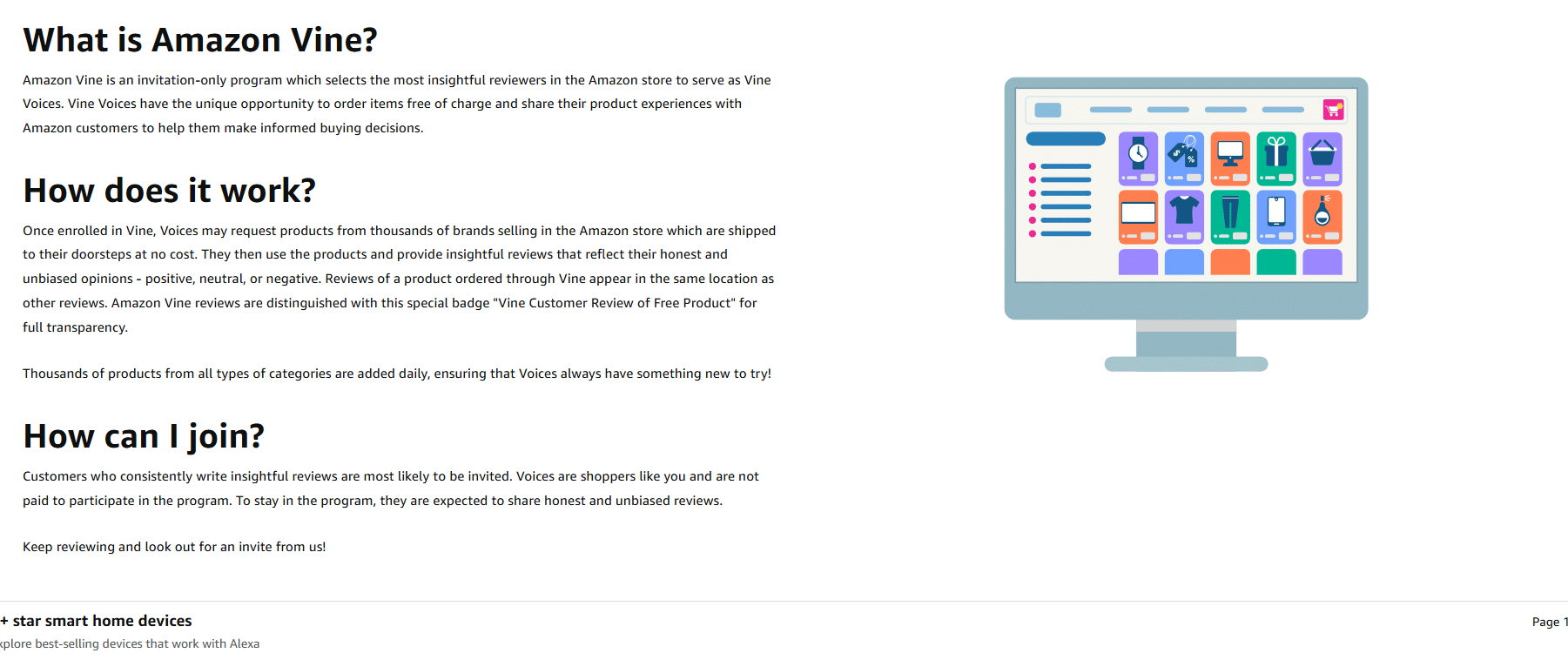
Image above: Amazon’s public Vine explainer shows how Vine Voices receive products at no cost and share their product experiences.
Who Qualifies for Amazon Vine?
For the branded products this article is focused on, there are several things that generally need to be true before you can use Vine.
- You need a Professional selling account.
- Your brand needs to be enrolled in Amazon Brand Registry.
- You need the appropriate Brand Representative or Reseller role connected to the brand.
- The product needs to have fewer than 30 reviews on the detail page.
- The offer needs to use Fulfillment by Amazon (FBA).
- The listing needs an image and description.
- The product cannot fall into one of Amazon’s excluded product types.
If you’re still getting the brand side set up, see our guide on how Amazon Brand Registry works and what it actually does.
One issue I occasionally run into is that the brand is registered correctly, but Seller Central still doesn’t recognize a particular ASIN as being connected to that brand.
Usually, the brand name on the listing needs to match the registered brand correctly. If everything appears right but Amazon still says the ASIN isn’t eligible for the brand benefit, you may have to get that connection fixed before Vine will work.
The other major requirement is FBA. Vine products are fulfilled by Amazon so the reviewer’s identity and shipping information stay separate from the seller. If you normally fulfill your products yourself, our FBA vs. FBM guide goes through the broader differences between those two fulfillment methods.
There are also more specific product restrictions. If Seller Central unexpectedly says an ASIN isn’t eligible, check the detailed Amazon Vine requirements before assuming the dashboard is broken.
A Useful 2026 Feature: Pre-Launch Vine
Amazon now specifically supports pre-launch Vine enrollment.
You can create an eligible FBA listing, set the Product Site Launch Date in the future, enroll the product in Vine, and potentially start building reviews before regular customers can purchase the product.
Amazon currently recommends having the inventory available in its fulfillment network at least three weeks before the planned launch date so Vine reviewers have time to receive, try, and review the product.
You can review Amazon’s current pre-launch Vine FAQ for the current details.
This can be really useful.
Instead of launching with:
0 reviews
you may be able to launch with:
several Vine reviews already visible.
That helps eliminate one of the biggest problems with a cold-start product: asking the first real customer to take a chance on something nobody has reviewed yet.
If you’re planning a broader new-product launch, our first three months selling on Amazon guide also covers where Vine can fit into the launch timeline.
How Much Does Amazon Vine Cost?
There are really three separate costs to think about.
1. The Vine enrollment fee
| Units Enrolled | Enrollment Fee |
|---|---|
| 1–2 units | $0 |
| 3–10 units | $75 |
| 11–30 units | $200 |
You can verify the current rate card on Amazon’s Vine enrollment fee page.
The fee is based on the number of units you enroll, not the number that eventually get claimed or reviewed.
Suppose you enroll 30 units, which puts you in the $200 tier, but your product is very niche and only five Vine reviewers end up requesting it.
You don’t get your enrollment fee reduced to the 3–10 unit tier just because only five units were claimed. The fee was based on the enrollment tier.
2. FBA fulfillment fees
The product still has to be shipped to the Vine Voice.
Amazon handles that through FBA, so you also need to account for the fulfillment cost of getting each claimed unit to the reviewer. Bigger and heavier products generally create higher fulfillment costs than tiny, lightweight products.
If you’re modeling the economics, our Amazon fees guide explains how FBA fulfillment fees fit into the rest of your Amazon costs.
3. The product itself
You’re giving the unit away.
If your landed product cost is $5, giving away 30 units costs you $150 in inventory before fulfillment costs.
If your landed product cost is $100, those same 30 products represent $3,000 in inventory.
That’s why the exact same Vine strategy can make perfect sense for one product and be much harder to justify for another.
| Cost | What You’re Paying For | Why It Matters |
|---|---|---|
| Enrollment fee | The Vine enrollment tier | Up to $200 for 11–30 units |
| FBA fulfillment | Getting claimed units to Vine reviewers | Larger and heavier products cost more to fulfill |
| Product cost | The inventory you give away | Can become substantial for expensive products |
New Seller Incentives Can Cover the Vine Fee
If you’re a new seller and qualify for Amazon’s New Seller Incentives, Amazon currently advertises a $200 Vine credit for eligible sellers who enroll their brand in Brand Registry.
That can effectively cover the current $200 enrollment fee for an 11–30 unit enrollment.
There are eligibility requirements and deadlines, so don’t assume the credit will automatically be there whenever you decide to enroll. Our Amazon New Seller Incentives 2026 guide goes through the larger program.
And remember: a $200 Vine credit addresses the enrollment fee. It does not make the inventory itself free.
What Vine Reviewers Are Actually Like
This is where a lot of brands get surprised.
Vine reviewers are not necessarily representative of the person most likely to buy your product.
They tend to write longer and more detailed reviews. Many of them review a lot of similar products, so they know what to look for. That can make their feedback useful, but it can also make them pickier than your average customer.
For example, a reviewer might really like the product but think your price is a little high compared with competitors.
A normal customer who specifically chose your product may still give it five stars because it did exactly what they wanted.
A Vine reviewer may basically say:
The product is great. It works. The quality is good. But it seems expensive compared to similar products.
And then give you four stars.
I’ve found that a lot of Vine reviewers make you really earn that fifth star.
That doesn’t mean they’re unfair. In many cases, they’re giving a thoughtful review. You just need to understand that receiving the product for free does not mean they’re supposed to give you a positive rating.
Vine Reviews Don’t Necessarily Affect the Star Rating the Way You Expect
Another thing sellers sometimes misunderstand is the overall star rating.
Amazon does not simply take every rating, add them together, and divide by the number of reviews.
Based on what I’ve seen across products, Vine reviews can also appear to have much less influence on the displayed star rating than a strong verified-purchase review from someone who actually bought the product.
I once saw a product with roughly ten five-star Vine reviews. Then its first real verified-purchase review came in at one star, and the overall displayed rating dropped to around two stars.
If all of those reviews were being weighted exactly the same, the math obviously wouldn’t work that way.
The practical point is that I would not assume 20 or 30 good Vine reviews will protect you forever from bad reviews.
What really matters over time is whether the actual customers choosing the product and paying for it like the product.
Products That Tend to Be Good Fits for Amazon Vine
| Usually Better Fits | Higher-Risk Fits |
|---|---|
| Lower-cost products | Expensive products |
| Small or lightweight products | Large products with higher fulfillment costs |
| Products with broad appeal | Products designed for a very narrow customer |
| Products most people can understand easily | Products requiring specialized circumstances or knowledge |
| Products with a clear value proposition | Premium products whose extra value may not be obvious |
| Products with clear instructions | Products that are easy to use incorrectly |
| Products with strong quality control | Products with unresolved quality problems |
Lower-cost products
Low-cost products are usually the easiest decision. Your inventory cost for giving away 30 units is relatively small, and products selling at higher volume may have an easier time collecting additional reviews from normal customers later.
Products with mass-market appeal
If almost anyone can use and benefit from the product, the Vine reviewer is more likely to be a reasonable stand-in for your real customer.
Products you’re confident are genuinely good
If the product isn’t good enough to stand up to 30 relatively impartial reviewers, I’d question whether it should be launched in its current form anyway.
Sometimes negative Vine feedback can actually be useful because it exposes a problem before hundreds of paying customers encounter the same thing.
Products That Are Riskier for Vine
Expensive products
Thirty $5 units and thirty $200 units are two completely different financial decisions.
The difficult part is that expensive products can simultaneously be some of the products that need Vine the most because they may sell more slowly and therefore collect organic reviews more slowly.
Very niche products
The narrower your ideal customer is, the less representative the average Vine Voice may be.
Imagine a dietary supplement designed for a very specific person whose hormones are out of balance.
A Vine reviewer who does not have that problem may try it and notice no benefit at all. In a worse situation, something formulated for that specific need could create an unpleasant experience for somebody who doesn’t have it.
That doesn’t necessarily prove the product is bad for its intended customer. It may mean the reviewer simply wasn’t the person it was designed for.
The more your product depends on exactly the right person using it, the more careful I’d be.
Premium products whose value isn’t obvious
Suppose competing products cost $40 and yours costs $80.
Your target customer is willing to spend $80 because your product has a specific feature or benefit the $40 alternatives don’t have.
But the Vine reviewer may not be the person who needs that benefit.
They see:
Competitor: $40
Your product: $80
And their conclusion may simply be that your product is overpriced.
Your Listing Can Have a Huge Effect on Your Vine Reviews
I would get the listing into really good shape before enrolling in Vine.
- Have very clear instructions.
- Put important usage instructions in the listing and include directions with the physical product.
- If sizing matters, provide a very clear sizing chart.
- Clearly explain what the product is compatible with.
- Clearly explain what it is not compatible with.
- If the product contains ingredients, make those ingredients obvious.
- For food or supplements, include the appropriate nutrition or supplement information in the images.
- Explain unusual features or experiences customers should expect.
- Make sure there aren’t unresolved quality-control problems.
| Question to Answer Before Vine | Why It Matters |
|---|---|
| Is the product genuinely ready for impartial reviews? | Vine reviewers can leave negative reviews. |
| Is the listing complete and accurate? | Bad expectations can create unnecessary negative reviews. |
| Are the instructions clear? | A reviewer may blame the product if they use it incorrectly. |
| Is sizing clearly explained? | Wrong size selection can create avoidable complaints. |
| Are compatibility limitations obvious? | Reviewers need to know what the product does and does not work with. |
| Can a typical reviewer understand the product’s value? | Especially important for niche or premium products. |
| Can you afford to give away the enrolled inventory? | The product cost is part of the real Vine expense. |
Change the Listing When Early Reviews Reveal Confusion
If someone points out an issue you didn’t anticipate, update the listing as soon as possible.
Maybe people are misunderstanding the size. Maybe they think the product is compatible with something it isn’t. Maybe they don’t understand a specific ingredient. Maybe they’re using it incorrectly.
Fix that information before the next reviewers go through the same experience.
A Real Example: When a “Negative” Product Characteristic Needs to Be Explained
I once worked with a dietary supplement that contained alcohol.
The alcohol served an important purpose because it helped the product absorb into the bloodstream effectively.
But there was a tradeoff: it could cause a burning sensation.
If customers weren’t expecting that, they could try the product, feel the burning, assume something was wrong, and leave a negative review.
We needed to make the burning sensation very obvious in the listing and explain why that characteristic existed.
What If Your Vine Reviews Start Coming In Negative?
Don’t just sit there and watch another 20 units get claimed.
- Are reviewers using the product incorrectly?
- Did they expect something different from what they received?
- Is the listing missing important information?
- Is there a quality-control problem?
- Are people repeatedly complaining about the price?
- Is the product being reviewed by people who aren’t really the target customer?
If units have already been claimed, stopping the remaining enrollment does not bring those claimed units back, and those reviews may still come through.
When a Bad Rating Becomes a Bigger Problem
If virtually every legitimate competitor is around four to four-and-a-half stars and you’re around three stars, that’s a problem.
And if real verified-purchase reviews coming in after Vine are also negative, then you probably don’t have a Vine problem anymore.
You have a product, positioning, price, or customer-expectation problem.
Should You Ever Relaunch the Product?
If the situation becomes really bad, one option is to relaunch the product under a new UPC and start with a new listing.
I consider that a last resort.
If the underlying product problem still exists, you’re just going to recreate the same problem on the second listing.
Fix the reason for the bad reviews before relaunching.
How Many Units Should You Enroll in Vine?
If I’ve decided a client is a good fit for Vine, I almost always lean toward enrolling the full 30 units.
I’ve had clients choose 10 or fewer because they were nervous about giving away inventory, and a lot of them later regretted it because the program worked fine and they wished they had taken the opportunity to get more reviews.
That doesn’t mean everybody should blindly enroll 30 units. If you’re giving away an extremely expensive product or have a very niche product, you may intentionally accept fewer potential reviews to reduce your exposure.
Don’t Panic If Nobody Claims the Product Right Away
Vine claims don’t necessarily come in at a steady rate.
I’ve seen products sit there for a week or two without much happening and then suddenly have a bunch of units claimed within a few days.
So if you enroll 30 units and almost nothing happens immediately, don’t automatically assume the program failed.
How to Enroll a Product in Amazon Vine
- Go to Amazon Vine in Seller Central.
- Enter the ASIN you want to enroll and select Begin enrollment.
- Verify the product information on the enrollment page.
- For a standalone ASIN, enter the number of units you want to make available, from 1 to 30.
- For a variation family, select the eligible variations you want included.
- Review the enrollment details.
- Review the applicable enrollment fee and Vine terms.
- Complete the enrollment.
- Monitor the product through the Vine dashboard.
You can also review Amazon’s current Amazon Vine enrollment instructions.
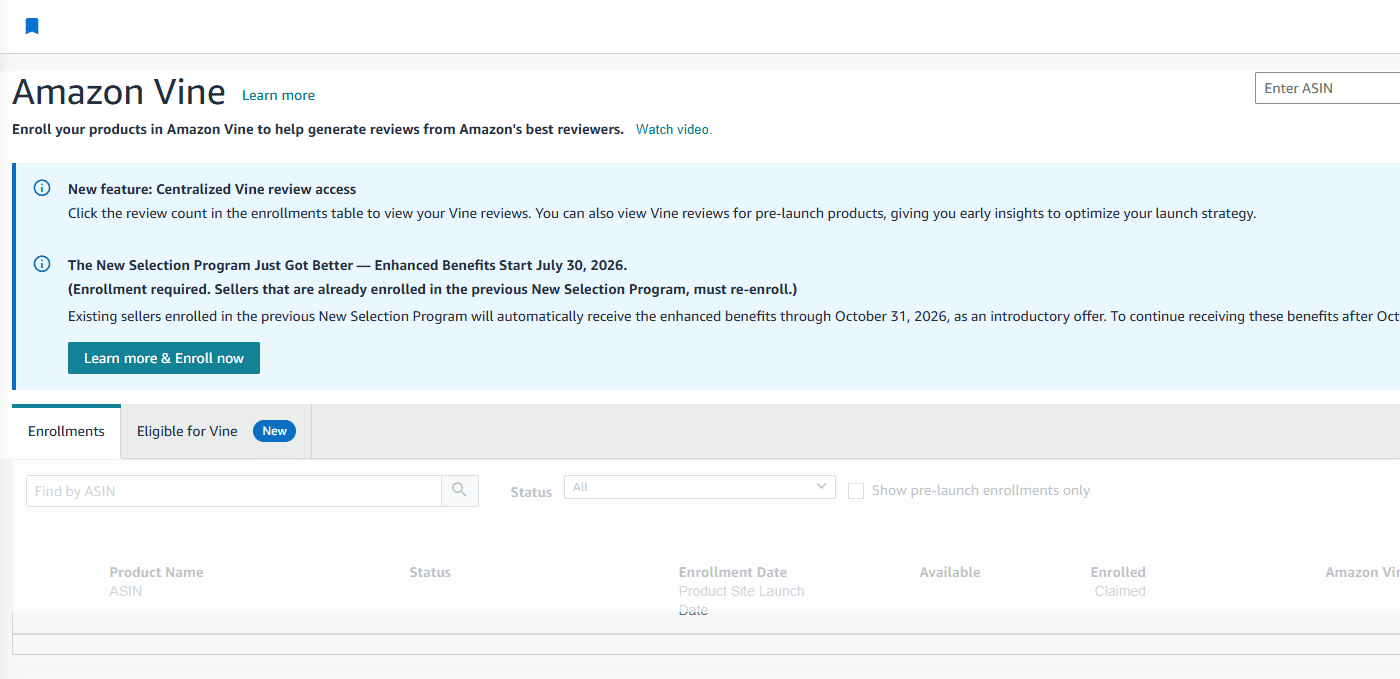
Image above: This is the Amazon Vine dashboard in Seller Central, where you can monitor enrollments and check products for Vine eligibility.
Amazon Vine Is Not the Only Way to Get Reviews
Whether you use Vine or not, you should still have a normal review strategy for actual customers.
Use Amazon’s Request a Review feature
Amazon has a built-in Request a Review feature for orders.
You can do it manually.
The problem is that most brands won’t remember to go into Seller Central and manually request a review on every eligible order.
That’s why I generally prefer automating the process.
Automate review requests with software such as sellerboard
A tool like sellerboard can automate Amazon review requests rather than relying on somebody to remember to do them manually.
It also does quite a bit beyond review requests, including profit analytics, inventory tools, PPC tools, listing-change alerts, and other Amazon seller functions.
The screenshot below shows sellerboard and where review requests fit alongside its other Amazon seller tools.
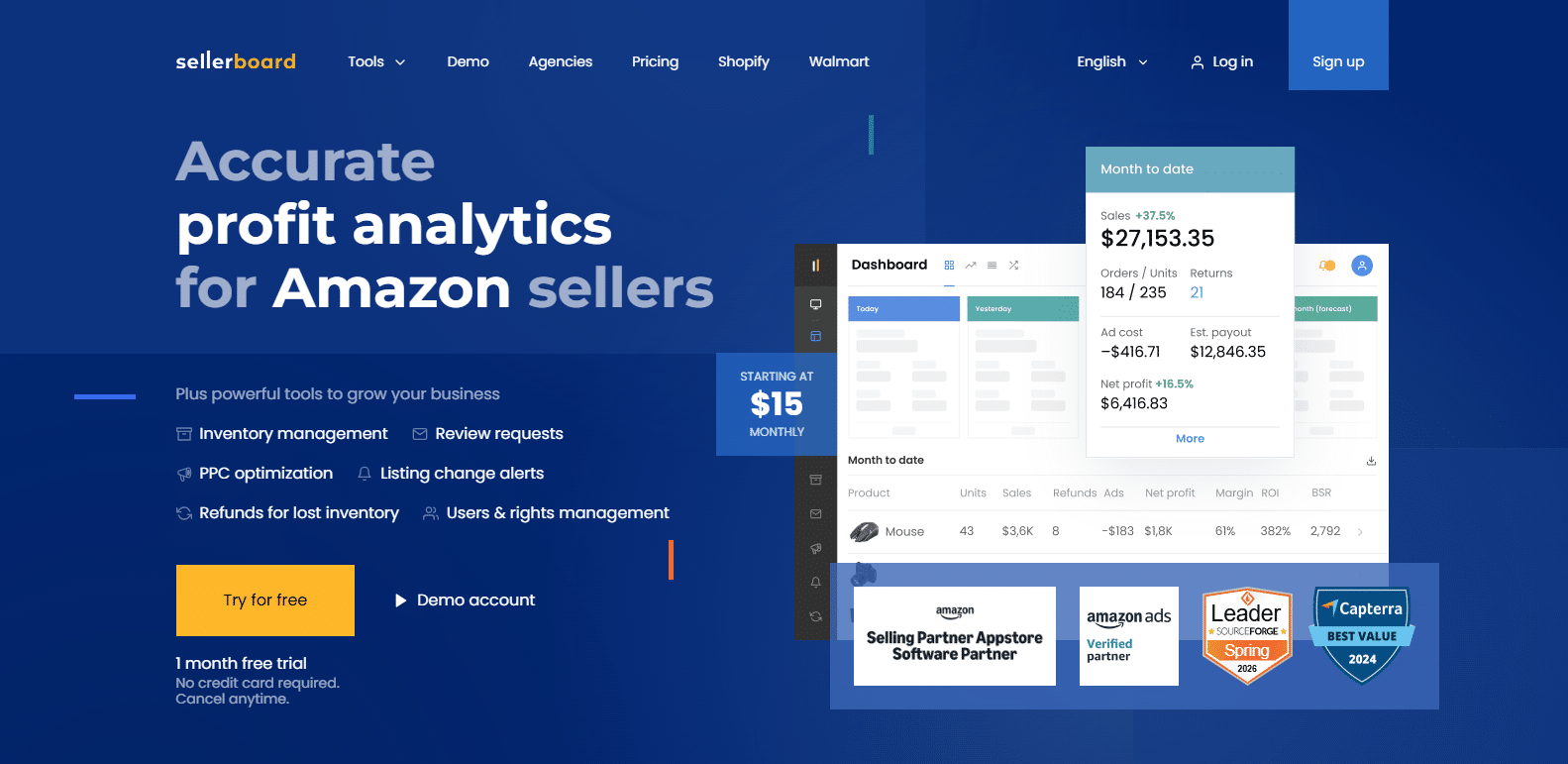
Image above: sellerboard includes automated review requests alongside profit analytics, inventory, PPC, and listing-monitoring tools.
Use product inserts carefully
You can also include a small insert with the physical product reminding customers that they can leave an honest review.
A QR code can make that process easier.
The important thing is that you cannot manipulate the review.
Don’t say:
“Leave us a five-star review.”
Don’t offer a discount, refund, free product, gift card, or future benefit in exchange for leaving a review.
Don’t send happy customers toward the review page while routing unhappy customers somewhere else.
Amazon’s Community Guidelines prohibit compensated or incentivized reviews and reviews involving certain personal or financial conflicts of interest.
A neutral reminder to share an honest experience is very different from trying to control what the customer says.
Use an existing customer audience carefully
If your brand already has a legitimate customer base outside Amazon, that audience can help create initial Amazon traction too.
For example, you may have an email list of actual customers who already know and like the brand.
But there’s an important line here.
Do not ask friends, relatives, employees, business associates, or other people with a personal or financial connection to manufacture reviews for you.
Also be very careful about combining large discounts or other promotions with a request for reviews. Never make a benefit contingent on leaving a review.
Why Trying to “Cheat” Reviews Is a Bad Strategy
I still occasionally see brands think they can just get friends and family to buy the product and review it.
That’s not something I recommend.
Amazon has a lot of information available to it about customer activity, and sellers shouldn’t assume that just because Amazon can’t visibly prove two people know each other, the activity will never be detected.
The broader point is simple:
You need a product that can earn good reviews from real customers.
No review tactic is going to fix a product that customers don’t like.
One of the Best Uses of Early Reviews Is Learning What’s Actually Wrong
Suppose you launch a product with no reviews and it doesn’t sell.
Maybe customers don’t trust it because it has zero reviews.
Maybe the price is wrong.
Maybe the listing is bad.
Maybe the product itself isn’t appealing.
Getting some reviews gives you another data point.
If Vine reviewers generally like the product but sales are still weak, maybe reviews weren’t the main problem.
If Vine reviewers repeatedly complain about the exact same feature, you’ve probably found something that needs to be fixed.
Some Products Can Launch Without Vine
Vine is useful, but it isn’t mandatory.
Some products have a very hard time generating sales when they have zero reviews.
Other products can begin selling without many reviews because the product is unique, the brand already has demand, the listing is strong, the price is compelling, or outside traffic is bringing people in.
So I wouldn’t use Vine merely because somebody said every new ASIN has to use it.
Is Amazon Vine Worth It?
For a lot of brands, yes.
If you have a relatively low-cost product with broad appeal, you’re confident in the quality, your listing is already very clear, and you need early social proof, Vine is usually one of the first things I’d consider.
I’m more cautious if:
- The product is extremely expensive to give away.
- FBA fulfillment costs are unusually high.
- The product only makes sense for a very narrow customer.
- The value proposition depends on a premium price that the average reviewer may not understand.
- The listing isn’t finished.
- The directions aren’t clear.
- You know there are still quality-control problems.
- One or two negative reviews could put the entire launch in a very difficult position.
Vine can help you get reviews.
It cannot make people like something they genuinely don’t like.
Amazon Vine FAQ
Does Amazon Vine guarantee 30 reviews?
No. You can make up to 30 units available, but reviewers choose whether they want the product, and Amazon does not guarantee that every claimed unit will result in a review. In my experience, enrolling 30 often produces around 28 or 29 reviews, but that is an observation, not a guarantee.
How much does Amazon Vine cost?
For U.S. enrollments, Amazon currently charges $0 for 1–2 enrolled units, $75 for 3–10, and $200 for 11–30. You should also account for your product cost and applicable FBA fulfillment costs.
Do I pay $200 if I enroll 30 units but only five get claimed?
If you enrolled in the 11–30 unit tier and the enrollment generates a review that triggers the fee, the fee is based on units enrolled rather than the number ultimately claimed.
Should I enroll all 30 units?
If I have already decided the product is a good fit for Vine, I normally lean toward the full 30. For expensive or unusually risky products, though, the economics may justify a smaller enrollment.
Can I use Vine before my product launches?
Yes. Amazon supports pre-launch Vine enrollment for eligible products.
Can Vine reviewers leave negative reviews?
Absolutely. Vine Voices are expected to give honest and unbiased opinions. Receiving the product for free does not obligate them to give you a good rating.
Are Vine reviewers harsher than normal customers?
In my experience, they often can be a little more critical. They tend to write detailed reviews, compare similar products, and may deduct a star for things like price even when they otherwise like the product.
Can I stop Vine if the reviews are going badly?
You may be able to stop the remaining enrollment, but units that have already been claimed cannot simply be recalled, and reviews from those units may still be published.
What if my normal customers are leaving bad reviews too?
Then I would stop thinking of it as a Vine problem. Look at the recurring complaints and fix the product, price, listing, expectations, directions, or quality-control issue that is causing real customers to be unhappy.
My Overall Recommendation
I like Amazon Vine a lot when the product is right for it.
The fastest way to make the decision is to ask yourself a few things:
- Is the product good enough that I’m comfortable handing it to impartial reviewers?
- Will a typical Vine Voice understand who the product is for and why it’s useful?
- Can I afford the inventory and fulfillment costs?
- Is my listing clear enough that nobody should be surprised by what arrives?
- Would 20–30 early reviews materially improve the launch?
If the answers are mostly yes, I’m usually in favor of Vine, and most of the time I’m going to use the full 30 units.
If the product is very niche, very expensive, unusually easy to misunderstand, or still has unresolved product issues, I’d think much more carefully before doing it.
And remember that Vine is only the beginning. Long term, the reviews that matter most are the ones you earn from actual customers who deliberately choose your product, pay for it, use it, and decide they like it.
If you want a walkthrough, the video above covers this step-by-step. If you’ve got a quick question about whether Vine makes sense for your product, leave a comment on the video. And if your situation is more complex and you want professional help, reach out to us at customerservice@fivestarcommerce.com.