
If you’re helping launch a product brand on Amazon—or you’re already running one—this is one of those areas you can’t afford to be fuzzy on.
Amazon fees are not just something that shows up after the sale. They shape your margins, your pricing, your packaging, your listing structure, and in some cases whether a product even makes sense to sell on Amazon at all.
Most brands don’t learn this early enough. They treat Amazon like any other channel, list products, and only later realize the economics don’t behave the way they expected.
Why understanding Amazon fees early changes how you build the offer
One of the most common patterns I see is brands treating fees as something to calculate after the product is already set up.
But Amazon doesn’t work that way.
I worked with a brand where customers naturally bought multiple units at a time—usually two or three.
Because the product was listed as a single unit, Amazon charged the fulfillment fee separately for each unit. So a 3-unit order meant three fulfillment fees.
Once they switched to a 3-pack listing, that changed to a single fulfillment fee for the bundle.
Example: Single Unit vs 3-Pack Fee Impact
| Scenario | Units Ordered | Fulfillment Fees Charged | Relative Cost |
|---|---|---|---|
| Single-unit listing | 3 units | 3 separate fees | Highest |
| 3-pack listing | 1 bundle | 1 bundled fee | Significantly lower |
This is the bigger takeaway: Amazon fees don’t just affect profit—they should influence how you structure the offer.
The Amazon referral fee
The referral fee is the most consistent and predictable fee on Amazon.
If you’re trying to quickly estimate margins, this is usually the first number you should calculate—because it applies to almost every product and every sale.
But even though it’s simple on the surface, there are a few details that change how it behaves in practice.
This is is Amazon’s commission on every sale. If you sell on Amazon, you pay this—whether you use FBA or ship orders yourself.
In most categories, it’s about 15% of the total order value, including shipping.
So if you sell a product for $30, Amazon takes about $4.50.
This matters because it scales with your price. Every pricing decision directly impacts this fee.
Example: Referral Fee Calculation
| Sale Price | Referral % | Referral Fee |
|---|---|---|
| $20 | 15% | $3.00 |
| $30 | 15% | $4.50 |
| $50 | 15% | $7.50 |
Not every category is 15%
15% is the rule of thumb—but not the rule.
Some categories have different base fees, and some change depending on price.
| Category | Referral Fee |
|---|---|
| Most categories | 15% |
| Consumer electronics | ~8% |
| Business / Industrial / Scientific | ~12% |
| Automotive & Powersports | ~12% |
| Grocery (under $15) | ~8% |
Some categories also change based on price tiers.
Example: Clothing Fee Tiers
| Price | Referral Fee |
|---|---|
| Under $15 | 5% |
| $15–$20 | 10% |
| Over $20 | 17% |
If your product sits near one of these thresholds, a small pricing change can change your fee percentage—not just your revenue.
Shipping does not reduce the referral fee
Sometimes brands try to lower the product price and increase the shipping charge, thinking it will reduce the referral fee.
For example: $25 + $5 shipping instead of $30 with free shipping.
But Amazon calculates the referral fee on the total order value—including shipping.
| Product Price | Shipping | Total | Referral Fee |
|---|---|---|---|
| $30 | Free | $30 | $4.50 |
| $25 | $5 | $30 | $4.50 |
So this doesn’t change your fee—it just changes how the price is presented.
What happens on returns
When a product is returned, Amazon refunds most of the referral fee—but not all of it.
They keep a small portion as an administrative fee.
| Scenario | Referral Fee Paid | Refunded | Net Cost |
|---|---|---|---|
| Sale | $4.50 | — | $4.50 |
| Return | $4.50 | ~$3.60 | ~$0.90 |
On its own, this isn’t a major cost—but it’s part of a broader set of return-related fees that matter more when you look at the full picture.
A first-year referral fee incentive some new brands should know about
Amazon has offered a new seller incentive for many brands launching on the platform.
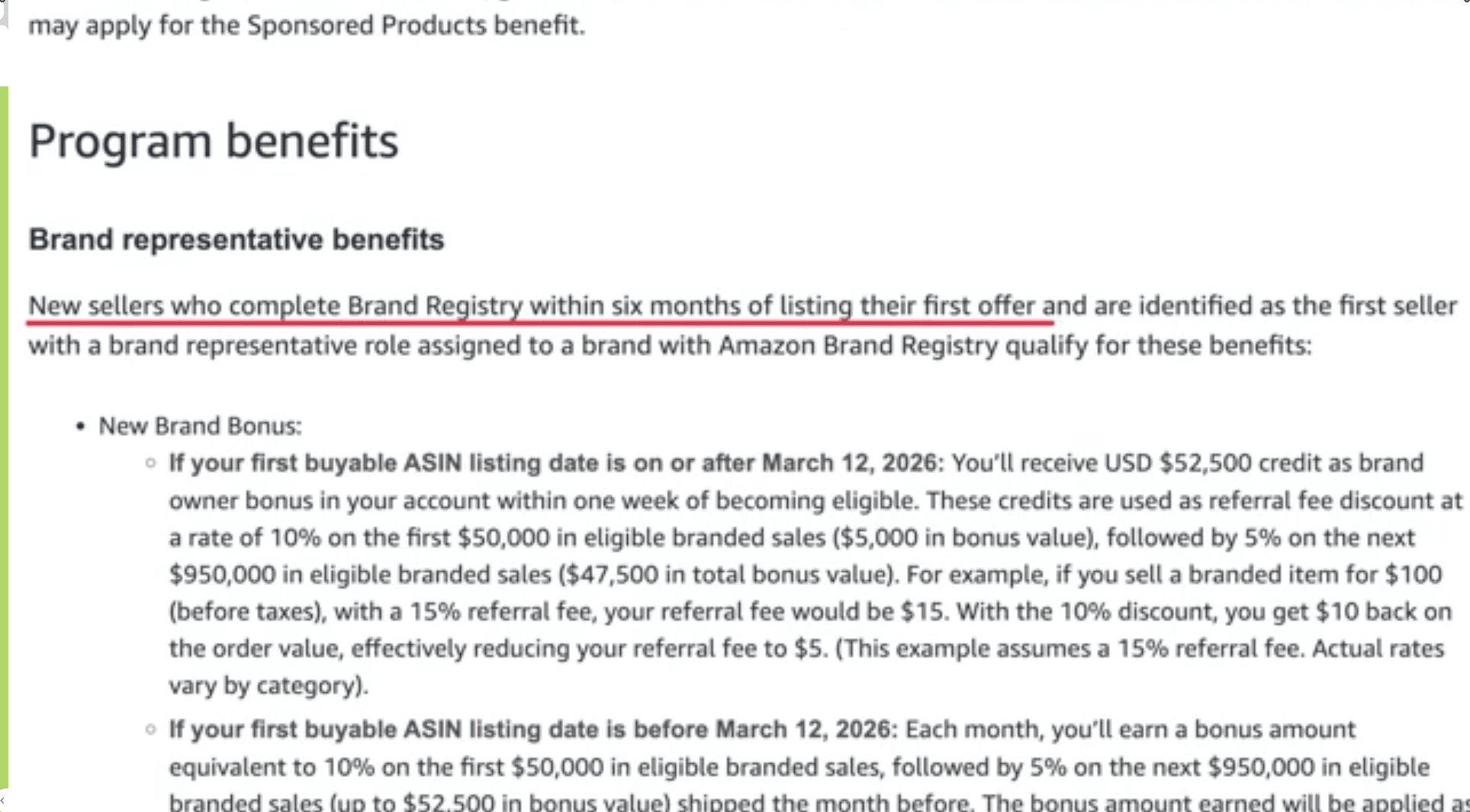
If you qualify, Amazon rebates part of your referral fees during your first year.
- 10% rebate on the first $50,000
- 5% rebate on the next $950,000
| Revenue Tier | Standard Fee | Effective Fee |
|---|---|---|
| First $50K | 15% | ~5% |
| Next $950K | 15% | ~10% |
This can improve early margins—but shouldn’t be relied on long-term. Remember this happens for the first year that you're selling on Amazon. Note that this requires a brand to be brand registered within 6 months of first having a listing go live on Amazon. They also need to be the first seller brand registered for that particular brand and the credit doesn't apply to sales that happen before you're brand registered. You want to get brand registered as early as possible to maximize the credit you can receive from this program.
The Amazon fee calculator (useful—but not complete)
Amazon calls this the Amazon FBA Revenue Calculator.
This is usually one of the first tools brands use when they start looking at Amazon—and it’s helpful—but it’s also easy to misunderstand.
At a basic level, the calculator lets you input:
- Price
- Weight
- Dimensions
- Fulfillment method (FBA vs FBM)
From there, Amazon gives you an estimate of your referral fee, fulfillment fee, placement fees, and some storage costs.
That makes it a good starting point—but it’s not a complete answer.
What it’s actually good for
The calculator is most useful early on.
If you’re trying to answer, “Is this product even in the range of working on Amazon?”—this is a fast way to check.
It’s also useful for comparing scenarios.
For example:
- What happens if we change the price?
- What happens if we slightly reduce dimensions?
- What happens if we switch from FBM to FBA?
This kind of directional testing is where the calculator is valuable.
Where brands get into trouble
The problem is when brands treat the calculator as if it’s giving them a complete and final answer.
It’s not.
It doesn’t show every fee that might apply, and it doesn’t fully reflect real-world outcomes like returns.
| Included | Limitations |
|---|---|
| Referral fee | Misses unusual fees that happen in limited situations. |
| FBA fee | This doesn't take into account the difference in the fee during different parts of the year, or that you'll still pay this fee on orders that are returned. |
| Storage estimate | This one is great. But you need to also be aware of "aged inventory surcharges." |
So if you copy those numbers into a spreadsheet and assume they’re complete, you can still make bad decisions.
One detail that throws off a lot of estimates
If you use the calculator while logged out and click “continue as guest,” Amazon assumes you’re using an individual seller account.
That means it adds a $0.99 per-unit fee.
Most brands are using a professional account, so that fee shouldn’t be included.
If you don’t catch that, your margin estimate is off before you even start.
The right way to use the calculator is as a directional tool—not a replacement for understanding the fee structure itself.
Below is a screenshot of this Amazon revenue calculator which you can access
here

Seller account types (and why this actually matters)
Amazon offers two types of seller accounts, and the difference is simple on the surface—but it affects how you’re charged and how you operate.
The first is the individual account.
This one has no monthly fee, but Amazon charges $0.99 every time you sell a unit.
The second is the professional account.
This one costs $39.99 per month, but there’s no per-unit fee.
| Feature | Individual | Professional |
|---|---|---|
| Monthly fee | $0 | $39.99 |
| Per unit fee | $0.99 | $0 |
At a basic level, the math is straightforward.
If you sell more than 40 units per month, the professional account is already cheaper.
But for most brands, the decision isn’t really about the math—it’s about functionality.
The professional account is what allows you to run ads, use promotions, give team members access, and compete for the Buy Box.
So in practice, almost every real brand selling on Amazon should be using the professional account.
There’s also a small detail that’s easy to miss but matters when you’re modeling margins.
If you use Amazon’s fee calculator while logged out, it assumes you’re using an individual account and adds that $0.99 per-unit fee.
If you don’t catch that, your numbers will look worse than they actually are.
The FBA fulfillment fee (this is your real shipping cost)
The FBA fulfillment fee is what you pay Amazon to pick, pack, and ship your product to the customer.
If you’re using FBA, this is Amazon doing the job your warehouse and shipping carrier would normally do.
This is one of the most important fees to understand because it behaves completely differently from the referral fee.
The referral fee is based on price.
The fulfillment fee is based on size and weight.
| Fee Type | Based On |
|---|---|
| Referral fee | % of price |
| Fulfillment fee | Size & weight |
That means your packaging, dimensions, and how you configure the product can directly change your costs.
Even small changes can push a product into a different size tier, which changes the fee.
This is also why things like bundling matter.
Going back to the earlier example, selling a 3-pack as a bundle can result in one fulfillment fee instead of three separate ones.
That’s not a pricing change—that’s a structural change driven by how Amazon charges fees.
What happens when a customer returns the product
This is one of the most important details in the entire fee structure.
You do not get the fulfillment fee back when a product is returned.
Amazon already did the work of picking, packing, and shipping the order—so that cost is gone.
| Fee Type | Refunded on Return? |
|---|---|
| Referral fee | Mostly |
| Fulfillment fee | No |
This is where a lot of brands underestimate the impact of returns.
They think in terms of lost revenue—but the cost side matters just as much.
If you have a product with higher return rates, you’re paying fulfillment on orders that don’t stick.
How FBA compares to shipping it yourself
After the referral fee, this is usually the next biggest cost per unit.
And unlike the referral fee, this is where product design decisions start to matter a lot more.
A common question is whether FBA is more expensive than shipping products yourself.
In many cases, it’s actually comparable—and sometimes cheaper—than fast shipping.
The key is what you’re comparing it to.
FBA is typically providing 1–2 day delivery.
So the right comparison is not the cheapest slow shipping option—it’s the cost of delivering that product in 2 days.
| Factor | FBA | FBM |
|---|---|---|
| Speed | 1–2 day | Varies |
| Cost predictability | High | Variable |
| Labor | Amazon handles | You handle |
Another important detail is that FBA pricing is generally consistent across the continental U.S.
You’re not dealing with the same kind of zone-based variability you would with your own shipping setup.
That predictability can make margin planning a lot easier.
Peak season changes (this affects Q4 margins more than you expect)
FBA fulfillment fees increase during peak season, which typically runs from mid-October through mid-January.
Then they drop back down again after that period.
The increases are not huge per unit—but they add up quickly if you sell volume during Q4.
| Product Type | Increase |
|---|---|
| Small | $0.10–$0.30 |
| Large | $0.50–$0.70 |
| Oversized | ~$4 |
If most of your sales happen during the holidays, this needs to be built into your margin model.
Otherwise, you may think a product is profitable based on standard fees—but it becomes much tighter when it matters most.
Important Nuance
FBA fulfillment fees are based on the weight & dimensions of the product. A seller will input the weight & dimensions into Amazon. However, when Amaozn receives the product, they will measure the products themselves. Sometimes their measurement may vary from the sellers measurements. I've seen they usually seem to add a half an inch in their measurements. This doesn't seem to be on purpose but rather sometimes the boxes tend to settle a bit in shipment and Amazon is measuring quickly.
Sometimes you can see this cause different products of the exact same size (for example, different color options of the same product) to be charged different fulfillment fees. In some cases, Amazon's measurements may be totally incorrect. When that happens you can put in a request to have Amazon remeasure the product to fix the discrepency. If the issue is just a disagreement on the most accurate measurement, they make get a similar measurement again.
This means that it's often not a good idea to design product to be right below a size teir. If Amazon's measurement is a little different than yours, you may end up paying the higher fee anyway. If possible, design products to have some "cushion" between the top of their size teir and the next one to pay as small of a fee as possible.
FAQ
What is the Amazon referral fee?
The referral fee is Amazon’s commission on the sale. For most categories, it is around 15% of the total order value, including any shipping the customer pays.
Does Amazon charge the referral fee on shipping too?
Yes. Amazon calculates the referral fee based on the total order value, not just the item price. So charging separately for shipping does not reduce the referral fee.
Do you get the referral fee back if a customer returns the product?
Amazon usually refunds most of the referral fee, but not all of it. They keep a small portion as an administrative fee, and there can be other return-related costs depending on the situation.
Do you get the FBA fulfillment fee back on a return?
No. If Amazon already picked, packed, and shipped the order, that fulfillment fee is not refunded.
What is the difference between an individual and professional seller account?
The individual account has no monthly subscription fee, but Amazon charges $0.99 per unit sold. The professional account costs $39.99 per month and does not charge the extra per-unit fee.
Why does the Amazon fee calculator sometimes show a $0.99 fee?
If you use the calculator while logged out or continue as a guest, Amazon may assume you are using an individual seller account. That adds the $0.99 per-unit fee into the estimate.
Is the FBA fulfillment fee based on price?
No. Unlike the referral fee, the FBA fulfillment fee is generally based on the product’s size and weight rather than its selling price.
Do Amazon fulfillment fees increase during peak season?
Yes. Amazon typically increases FBA fulfillment fees during peak season, which usually runs from mid-October through mid-January.
Final thoughts
If you’re trying to figure out whether a product works on Amazon, these are the first fees you need to get right.
The referral fee is Amazon’s cut of the sale.
The fulfillment fee is what you pay to get the product to the customer.
And the account structure affects how you’re charged at a baseline level.
But the bigger point is this:
These fees don’t just affect your margins—they should influence how you build the product, how you package it, and how you list it.
The brands that understand this early make better decisions—and avoid a lot of expensive mistakes.
If your situation is more complex and you want help working through it, email customerservice@fivestarcommerce.com.