Amazon's Prime Big Deal Days event took place October 6–7, 2026. Some brands saw huge increases in sales, others had relatively small increases, and some brands actually performed worse than they did during last year's event.
But here's the more important question: Did the brands that offered discounts actually make more money, or would they have been better off not offering any discounts at all?
We manage Amazon accounts for a wide variety of product brands at Five Star Commerce, and I wanted to look at the actual sales results from nine of those brands. Some offered deals during the event, some discounted their prices without running an official Amazon event deal, and others didn't offer any discounts at all.
The results were pretty interesting. Some brands had much higher sales after offering discounts. Others sold significantly more units but didn't actually generate more revenue because of how much they discounted their products. And several brands experienced increased sales without running any kind of deal.
I'll go through the results from each brand, explain the different types of promotions available, and share what I've noticed from managing Amazon accounts through these events over the years.
The goal is to help you evaluate whether your own brand's results were typical and decide what approach makes the most sense for future Amazon sales events.
How Amazon Prime Big Deal Days Deals Work
Before looking at the results, it's useful to understand what we're actually comparing.
Amazon has several different types of promotions sellers can run, and they don't all work the same way.
For this particular event, one of the main options was to submit an official event deal through the Manage Promotions section of Seller Central.
These are the promotions that may display a special badge on your listing indicating that the product is part of Prime Big Deal Days.
Depending on the product and how Amazon is displaying deals that year, these promotions can also make your products eligible to appear in certain deals sections of the website or when customers filter their shopping results to see discounted products.
That additional visibility can be one of the reasons to participate in an official event deal rather than simply lowering your price.
Amazon does change the specifics of these promotions from year to year, so sellers need to look at the actual terms available for each event.
How Much Did Amazon Charge for Prime Big Deal Days Deals in 2026?
For the 2026 event, the standard deal fee was $100 per promotion, with a $50 early-submission fee available for eligible deals. Amazon also charged 1.5% of deal sales, with the percentage-based fee capped at $5,000.
| Fee or requirement | 2026 event terms |
|---|---|
| Standard deal fee | $100 per promotion |
| Eligible early-submission fee | $50 |
| Percentage-based fee | 1.5% of deal sales |
| Percentage-based fee cap | $5,000 |
| Product discount | Additional reduction in selling price |
| Deal visibility | Potential event badges and deals-related placement, subject to eligibility |
Amazon confirmed these terms in its official deal fee documentation. Sellers who submitted eligible Prime Big Deal Days promotions by August 5, 2026, could save $50 on the upfront fee.
That means you're paying Amazon to run the promotion, in addition to offering customers a discounted price.
For example, let's say you run a deal that generates $10,000 in sales.
The 1.5% fee would be $150. With the standard $100 deal fee, that would be $250 in promotional fees.
And that's before considering the amount of money you gave up through the actual discount.
If you normally sell a product for $50 and discount it to $40, you're already collecting $10 less per unit. You still have to pay for the product, fulfillment, advertising, and other expenses.
So while it may look great to see your sales increase during the event, you really need to understand whether those extra orders were profitable.
Other Types of Amazon Deals
Amazon has also offered Lightning Deals, Best Deals, Prime Exclusive Discounts, and other promotional options.
Historically, these different deal types had substantially different fees.
For example, Lightning Deals during major events previously had fees around $1,000. That was a significant expense, particularly for products that weren't already generating substantial sales.
For the 2026 event, the deal structure discussed above was much less expensive to get started with.
This changes the calculation for some brands.
When a Lightning Deal costs $1,000 just to run, it's difficult to justify testing it on a product that doesn't already sell very well.
But when the upfront fee is $100, or potentially $50 for eligible early submissions, testing these promotions becomes more realistic for a wider range of products.
Of course, you still have the percentage-based fees and the actual discount to consider. Lower upfront fees don't automatically mean the promotion will be profitable.
How We Compared the Sales Results
For this analysis, we're looking at nine brands with different types of products, sales volumes, and promotional strategies.
Some of these brands generate relatively modest sales volumes, while others sell several million dollars per month on Amazon.
We also have brands that sell seasonal products, consumable products that customers purchase repeatedly, fashion products, and products that appeal to a much broader audience.
An important detail when comparing the graphs is that Prime Big Deal Days happened on October 6–7 in 2026, but October 7–8 in 2025.
Because of that, the sales increases appear on slightly different days when comparing the two years.
The comparison graphs use different colored lines:
- Teal blue represents sales during the current period in 2026.
- Red represents the previous comparison period, where shown.
- Orange represents the same month in 2025.
Some of the graphs show daily sales while others show a more detailed hourly view.
We'll start with the brands that didn't participate in the event at all. That's important because it gives us a baseline for how much Amazon's increased traffic can affect sales even without a discount.
Brands That Did Not Run Any Deals During Prime Big Deal Days
One of the biggest mistakes brands make when evaluating an Amazon event is assuming that any increase in sales must have been caused by their promotion.
Amazon gets a lot of additional traffic during major sales events.
Customers who might not normally be shopping on Amazon that day visit the website specifically because of the event. And while they're there, they don't necessarily purchase only discounted products.
They may search for something else they need, reorder products they regularly buy, or purchase something they've already been planning to buy.
That means brands can benefit from the event without participating in it.
We saw that happen with several of the accounts we manage.
Brand 1: A Seasonal Summer Product That Didn't Offer Any Discounts
The first brand sells a seasonal product primarily associated with summer.
This brand didn't run an official deal or discount its products during Prime Big Deal Days in either 2025 or 2026.
Because the event occurs in October, it's also outside the product's primary selling season.
You might expect a product like this to have relatively little benefit from a major October shopping event.
But the sales graph showed a noticeable increase during the event days.
Sales were well above the surrounding days, including the comparison periods from the previous month and the same month last year.
The brand didn't do anything special to create that increase.
It didn't pay Amazon for additional deal placement, and it didn't reduce its prices.
The most likely explanation is that the increase in traffic to Amazon resulted in more customers encountering and purchasing the product.
This is a good example of why brands should be careful when deciding whether a promotion was actually successful.
If this brand had offered a 20% discount during the event and experienced that same increase, it might have been tempting to attribute the increased sales to the discount.
But because it didn't discount its products, we can see that at least some brands will benefit from these events regardless.
And in this case, the brand didn't sacrifice any of its normal selling price to get that increase.
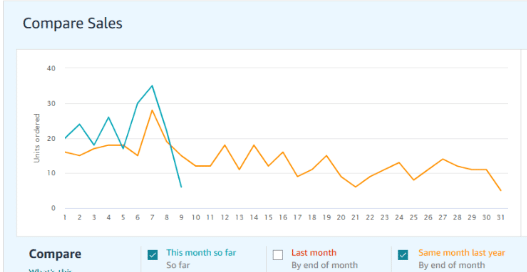
Image above: This seasonal brand experienced an increase in units ordered during Prime Big Deal Days 2026 despite offering no discounts.
Brand 2: Another Brand That Saw Increased Sales Without Participating
The next brand also didn't run deals in either year.
Its sales showed a similar pattern.
During the event, orders increased above their normal levels. Afterward, sales moved back toward their usual levels.
Again, there was no special promotion explaining the increase.
This brand was simply benefiting from the extra attention Amazon received during the event.
This is particularly useful when comparing other accounts that did offer discounts.
If a discounted product increases its sales by a modest amount, but comparable products without discounts also see similar increases, the discount might not have contributed very much.
In that situation, the brand could have sold more units while making less money per unit, without receiving much additional benefit.

Image above: Sales increased during the 2026 event even though this brand didn't run any deals. The arrow highlights the event-related increase.
Brand 3: No Deals Either Year, But a Much Bigger Increase in 2025
The third brand didn't run deals in either year either.
What makes this example interesting is that its results were quite different between the two events.
In 2025, the brand experienced a much larger increase during Prime Big Deal Days.
In 2026, there was still a bump, but it was considerably smaller.
The promotional approach was the same in both years.
So what changed?
There may have been differences in the account itself, the products, customer demand, organic rankings, or other factors affecting its sales.
The important point is that even when you keep your strategy exactly the same, results can vary from one year to another.
You can't necessarily assume that because your sales increased substantially during last year's event, you'll get the same increase the following year.
This is especially true when you aren't controlling all the factors that determine how customers find and purchase your products.

Image above: The highlighted area shows that this brand experienced a much larger event-related sales increase in 2025 than in 2026, despite offering no discounts in either year.
What These Three Brands Tell Us
Looking at these first three accounts, we can establish something important:
Most brands should expect at least some additional sales during major Amazon shopping events, even if they don't offer discounts.
That doesn't mean every product will see an increase, or that the increase will be the same every year.
But it does mean that increased sales alone aren't enough to prove that a deal worked.
When evaluating the results of a promotion, you have to consider how much additional traffic and sales you might have received without participating.
Otherwise, it's very easy to overestimate the benefit of the discount.
Brands That Offered Deals in 2026 but Not in 2025
Next, let's look at brands that changed their promotional strategies.
These examples are particularly interesting because we can compare a year when they offered no deals against a year when they decided to participate.
It's still not a perfect controlled comparison. Sales performance changes over time for plenty of reasons.
But it can help us understand whether offering discounts appears to be making a meaningful difference.
Brand 4: A Brand That Ran Deals This Year and Saw an Increase
This brand didn't run any event deals during Prime Big Deal Days in 2025.
If you look at its sales graph from last year, sales during the event were basically the same as normal days.
There wasn't much of an increase at all.
In 2026, the brand decided to offer deals.
This time, there was a clear increase in sales during the event.
It wasn't an enormous increase compared to some of the other brands we'll look at, but it was noticeable.
And because the brand hadn't experienced that increase the previous year without a deal, the promotion appears to have helped.
Of course, we'd still want to compare the incremental revenue and profit against the discounts and promotional fees.
But this is an example where participating in the event looks like it may have created additional demand rather than simply discounting purchases that would have happened anyway.
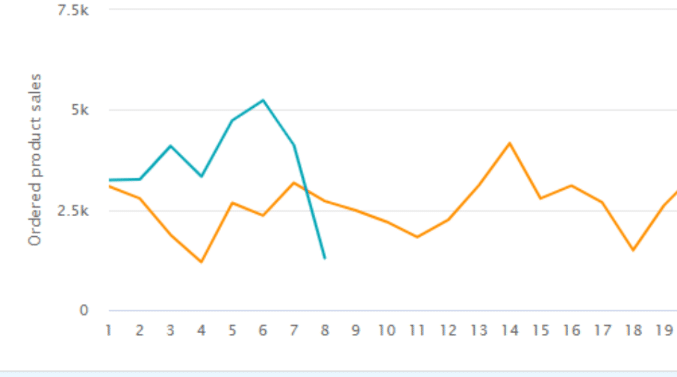
Image above: This brand offered deals in 2026 after not participating in 2025. Sales increased during the event, whereas the previous year's event showed little change.
Brand 5: A Halloween Product With a Large Increase in Sales
The next brand sells a Halloween-related product.
This is an interesting example because Prime Big Deal Days happens in early October, right before Halloween.
In 2025, the brand didn't offer any special discounts during the event.
Its sales didn't increase noticeably on the event days.
In 2026, it discounted its prices, and the results were very different.
There was a substantial increase in sales during Prime Big Deal Days.
At first glance, that might suggest that discounting was extremely effective.
But there's an important complication in this comparison.
The brand was relatively new in 2025, and the sales data also suggests it ran out of inventory later that month.
So we're not comparing two years in which everything else was equal.
In 2026, the product was more established, and there may have been other differences that contributed to the higher sales.
Still, the increase during the event was significant.
And because Halloween was only a few weeks away, customers had a reason to purchase the product during that period.
This is something brands selling seasonal products should consider.
A major shopping event that happens shortly before the product's peak season may create a useful opportunity to generate additional orders.
But the value of that opportunity depends on the discount, profitability, and how much demand would have occurred naturally as the seasonal peak approached.

Image above: This Halloween product experienced a large increase in orders after discounting prices for the 2026 event. Last year's comparison was affected by the product being relatively new.
Brand 6: Much Higher Unit Sales but Almost No Increase in Revenue
This next example is one of the most important from the entire analysis.
The brand sells a consumable product that customers may purchase repeatedly.
In 2025, it didn't offer a special deal during Prime Big Deal Days.
In 2026, it discounted its prices.
The number of units sold increased substantially during the event.
If we were looking only at unit sales, it would be easy to call this a very successful promotion.
But when we look at the actual revenue, the results are much less impressive.
Despite selling significantly more units, the brand generated approximately the same revenue as it did during the previous year's event without the discount.
In other words, the additional units sold were largely offset by the lower selling price.
The brand had to sell considerably more products to collect roughly the same amount of revenue.
And that creates an additional problem when we look at profitability.
Each additional unit sold has a product cost associated with it. There are also fulfillment expenses and potentially advertising expenses.
If the brand also pays fees for an official promotional deal, those expenses further reduce its profit.
So it's entirely possible that the brand made less profit during the event even though it sold substantially more units.
The main revenue benefit during the event appears to have come from the overall increase in Amazon traffic, rather than the discount producing a large additional increase in revenue.
That doesn't automatically mean the promotion was a mistake, though.
What If Customers Purchase the Product Again?
This product is something customers may need to reorder after they use it.
That changes the calculation.
Let's say a customer was considering trying the product for the first time and decided to purchase it because of the discount.
If that customer likes the product and continues purchasing it at the regular price, the brand may earn additional profit from future purchases.
In that case, it might be worthwhile to make very little money, or potentially even lose money, on the initial discounted order.
But you can't just assume those customers will come back.
You need to evaluate whether the customers acquired during the promotion actually purchase again at a rate high enough to justify the initial discount and expenses.
If they don't, then the brand may simply have sold more units for less profit.
And if most of those customers were already purchasing the product regularly, the promotion may have accomplished very little.
They may just have stocked up at the discounted price.
This is why I wouldn't evaluate this brand's promotion based on unit sales alone.
We'd want to consider the profitability of the event and whether it brought in enough valuable repeat customers to justify participating.
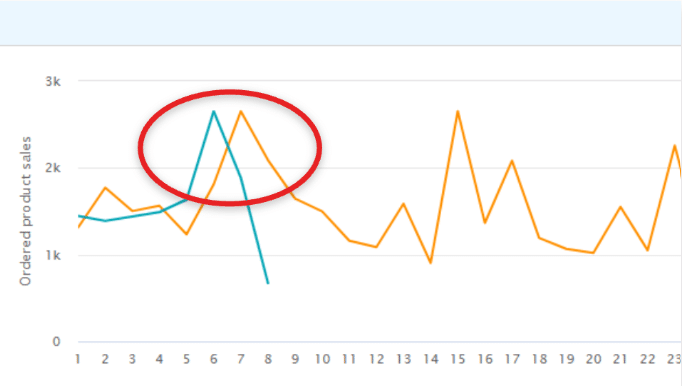
Image above: This repeat-purchase brand sold significantly more units after discounting, but the increase in volume did not translate into a comparable increase in revenue.
Brand 7: A Fashion Brand That Discounted Only Products It Wanted to Sell Through
The next brand is in the fashion category.
Rather than offering discounts across its entire catalog, it took a more selective approach.
It put approximately 5–10% of its products on deals.
And these weren't necessarily the products it wanted to sell the most of over the long term.
They were products the brand was already trying to sell through and discontinue.
In 2025, the brand hadn't participated in the event with deals.
In 2026, it ran promotions on those selected products.
Sales increased more during the event than they had the previous year.
So in this situation, the promotion appeared to accomplish what the brand wanted.
This is an example of how discounts can be useful even when maximizing profit per unit isn't the main objective.
For a fashion brand, older inventory can become increasingly difficult to sell as trends and seasons change.
If a brand wants to discontinue certain styles or clear out remaining inventory, accepting a lower profit margin may make sense.
The alternative could be holding on to the inventory much longer, continuing to pay storage expenses, or eventually selling it at an even lower price.
In this case, the brand didn't have to discount the entire catalog.
It selected specific products where increased sales volume was a priority.
That's an approach worth considering if you have certain products you want to sell through without reducing prices on your entire product line.
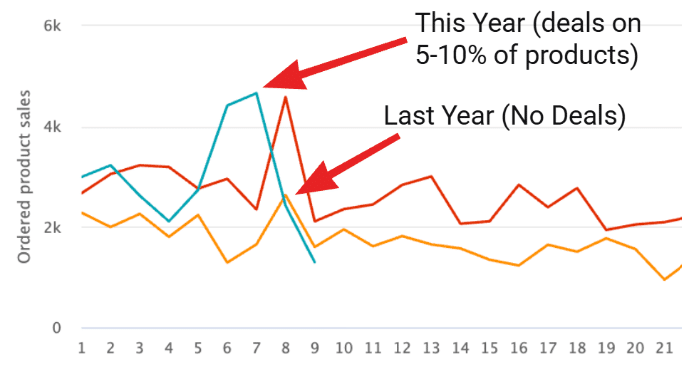
Image above: The fashion brand offered deals on approximately 5–10% of its products in 2026 and experienced a larger event-related sales increase than in 2025.
Brand 8: A Brand That Expanded Deals From One Product to Almost Its Entire Catalog
This next brand provides an especially useful comparison because it tested a promotion on a limited basis before expanding it.
In 2025, it ran a deal on just one product.
Most of the products in its catalog didn't participate in the event.
That first promotion was essentially a test.
In 2026, the brand decided to run deals on almost all of its products.
The difference in sales was substantial.
The brand generated considerably more sales during Prime Big Deal Days in 2026 than it did during the previous year's event.
While we can't attribute every bit of that growth to the expanded promotion, the results suggest that offering deals on more of the catalog was worthwhile for this brand.
This is also a good example of why brands don't necessarily need to commit their entire product line to an event the first time they participate.
You can start with one product or a small group of products.
See how customers respond.
Then use that information to decide whether to expand your participation during future events.
For some brands, that testing process will show that promotions are highly effective.
For others, it may show that discounts don't generate enough additional sales to justify the expense.
Either way, you're learning something useful about your own products.

Image above: After expanding deals from one product in 2025 to almost its entire catalog in 2026, this brand experienced a substantial sales increase during the event.
A Large Brand That Ran Deals in Both Years
The final brand is quite different from most of the previous examples.
This is a much larger business, generating several million dollars per month on Amazon.
It participated in Prime Big Deal Days in both 2025 and 2026.
Because of its size, we're looking at a more detailed view of sales during the event rather than just a simple month-long daily comparison.
Brand 9: Several Million Dollars in Monthly Sales With Strong Results Both Years
This brand ran deals during both events and experienced very large increases in sales.
Its 2026 performance was approximately the same as its 2025 performance.
Both years produced substantial event-related sales volume.
For a brand this size, that can represent a huge number of orders in a short period.
And when a product already sells at a high volume, discounts can make a much bigger difference.
There are several reasons for that.
First, the product already has a large customer base and substantial existing demand.
Second, if it appeals to a relatively broad audience, there are more potential customers who might decide to purchase it because of a temporary price reduction.
And third, an event deal can potentially increase visibility for products that are already attracting a lot of shoppers.
For this particular brand, the strategy has produced strong results in both years.
That's useful because the company isn't having to reinvent its promotional strategy every time Amazon runs a major event.
It has already established an approach that works well for its products and can use that experience when planning future promotions.
Of course, it should still evaluate profitability and keep an eye on changes to Amazon's fees and promotional options.
But this is an example of a large, established brand that has been able to consistently generate substantial sales during these events.
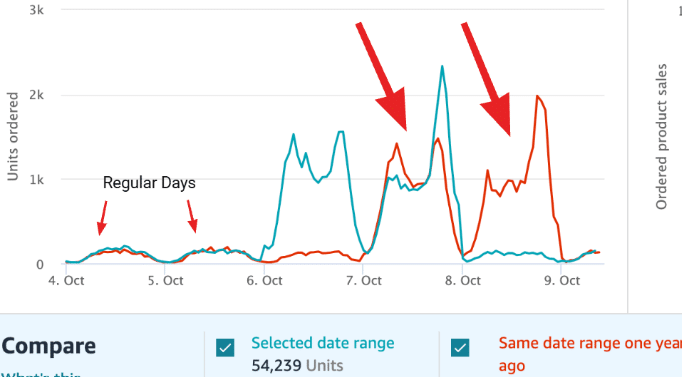
Image above: This large brand generated substantial order spikes in both years. The spikes fall on different dates because Prime Big Deal Days ran October 6–7 in 2026 and October 7–8 in 2025.
How Nine Brands Performed During Prime Big Deal Days
Here's a comparison of all nine brands and their promotional approaches. The important thing is that an increase in sales wasn't always tied directly to whether a brand offered a deal.
| Brand | 2025 strategy | 2026 strategy | Results |
|---|---|---|---|
| 1. Seasonal summer product | No deals | No deals | Noticeable increase without discounts. |
| 2. Brand with no deals | No deals | No deals | Sales increased from event traffic alone. |
| 3. Brand with inconsistent results | No deals | No deals | Larger event increase in 2025 than 2026. |
| 4. First-time event deal | No deals | Event deals | Clear sales increase in 2026. |
| 5. Halloween product | No discounts | Price discounts | Large increase; comparison affected by the brand being new in 2025. |
| 6. Repeat-purchase product | No discounts | Price discounts | Much higher units but approximately the same revenue. |
| 7. Fashion brand | No deals | Deals on 5–10% of products | Larger sales increase and useful inventory sell-through. |
| 8. Expanded catalog participation | Deal on one product | Deals on almost all products | Substantially higher sales in 2026. |
| 9. Large established brand | Event deals | Event deals | Very strong and approximately similar results both years. |
The individual results show why it's important to consider each brand's products, sales history, and goals rather than assuming one promotional strategy works for everyone.
Why More Units Sold Doesn't Necessarily Mean a Better Promotion
One of the most important lessons from these results is that brands need to be careful about which numbers they're evaluating.
Amazon makes it easy to look at sales and see whether revenue or unit volume increased during an event.
But those numbers don't necessarily tell you whether the event was financially worthwhile.
Imagine you normally sell a product for $30.
If you sell 100 units, that's $3,000 in revenue.
Now suppose you discount that product by 25%, reducing its price to $22.50.
You sell 130 units during the event.
That sounds like a successful promotion because unit sales increased by 30%.
But your revenue is now only $2,925.
You sold 30 additional units and still generated less total revenue.
Why Increased Unit Sales Don't Always Mean More Profit
| Metric | Regular sales | During 25% discount |
|---|---|---|
| Regular product price | $30.00 | $30.00 |
| Actual selling price | $30.00 | $22.50 |
| Units sold | 100 | 130 |
| Total revenue | $3,000.00 | $2,925.00 |
| Change in units | — | +30% |
| Change in revenue | — | −2.5% |
| Promotional fees | None | Additional, if applicable |
This is an illustrative example, not the actual performance of one of the nine brands.
Even though the brand sold 30% more units, revenue decreased by 2.5%.
And you've incurred the product and fulfillment costs associated with those extra 30 units.
That's before considering any promotional fees.
This is similar to what we saw with the consumable brand in our analysis.
Selling more units can be beneficial. But the additional volume needs to create enough value to compensate for the reduced price and associated expenses.
Amazon also provides deal performance reports showing orders, revenue, glance views, and conversion rates. These numbers are useful, but they don't tell the complete profitability story.
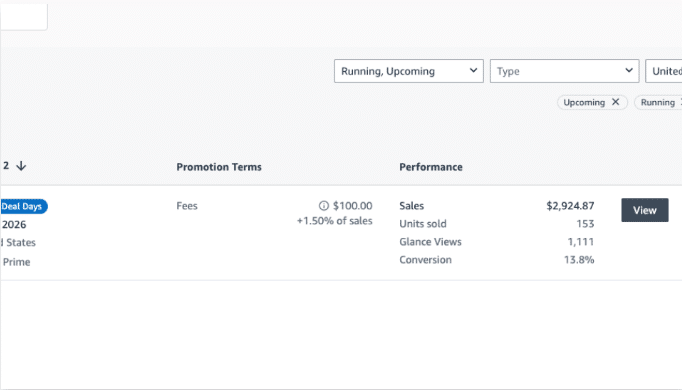
Image above: Amazon's promotion report shows sales, units sold, traffic, conversion, and fees. These figures are useful for measuring activity but don't show whether the promotion was profitable.
The report shows $2,924.87 in sales, 153 units sold, 1,111 glance views, and a conversion rate of 13.8%.
It also shows a $100 fee plus 1.5% of sales.
But it doesn't tell us what those units would have sold for without the promotion, how many would have sold anyway, or what the final profit was after discounts and expenses.
Those are the numbers we'd need to evaluate the financial results.
What Types of Products Benefit Most From Amazon Deals?
After managing accounts through multiple Prime Day and Prime Big Deal Days events, I've noticed a few consistent patterns.
The effectiveness of a deal depends quite a bit on the type of product you're selling and why customers normally buy it.
1. Products That Appeal to a Broad Audience Often Benefit the Most
Products with relatively broad appeal often respond very well to discounts.
These are products that many different types of customers might want, especially when the product is something people enjoy having but don't absolutely need to buy at a specific time.
A discount can encourage shoppers to purchase something they might otherwise have delayed buying or skipped entirely.
And if the product already sells well, a major event can create a very substantial increase in sales.
This is one reason brands already selling hundreds of thousands or millions of dollars each month may see much greater results from promotional events.
They're starting with a product that already has proven demand.
The deal can provide an additional reason for customers to purchase.
2. Products That Aren't Selling Well Usually Don't Become Successful Just Because They're Discounted
This is something I see brands misunderstand.
If you have a product that isn't selling particularly well on Amazon, running a Prime Day deal usually isn't going to suddenly turn it into a very successful product.
There may simply not be enough demand for it.
Or there may be other problems affecting sales, such as the product's positioning, its listing, or how customers perceive its value.
A promotion can make an attractive product more attractive.
But it generally can't create substantial demand for a product that customers weren't interested in purchasing in the first place.
That's why the largest brands and best-selling products often benefit much more from these events than products with very low existing sales volumes.
If you have a newer product, it can still be worth testing a promotion. You just shouldn't expect a massive increase simply because Amazon puts a deal badge on the listing.
3. Products Purchased for Specific Needs Often Respond Less to Discounts
I've also noticed that products people purchase for very specific reasons don't always benefit as much from major sales events.
Dietary supplements and products intended for particular health conditions are good examples.
Customers purchasing these products often have a specific need.
They aren't necessarily browsing Amazon looking for something interesting to buy because it's discounted.
They're searching for a particular kind of product that meets their needs.
If they find the product they want, they may purchase it regardless of whether Amazon is running a major event.
So offering a discount doesn't necessarily create much additional demand.
There will always be exceptions, and some products in these categories can perform well during events.
But in general, I wouldn't assume that a product serving a very specific need will get the same benefit as a product that appeals to a large number of impulse shoppers.
4. Impulse Purchases Can Be Particularly Effective
Products that people don't necessarily need, but might want if they see an attractive price, can perform very well during these events.
Imagine a customer browsing Amazon's deals section.
They see a product they weren't planning to purchase, but it's something that interests them.
Because the product is discounted for a limited time, they decide to order it.
That sale might never have happened at the regular price.
This is the type of purchasing behavior that can make major Amazon events very successful for certain products.
The promotion isn't simply giving a discount to someone who was already going to purchase.
It's helping convince someone to make a purchase they might not otherwise have made.
That's much more valuable.
Which Products Are Most Likely to Benefit From Amazon Deals?
| Product type | Typical response | What to consider |
|---|---|---|
| Broad-appeal consumer products | Often strong | Discounts may encourage additional purchases. |
| Established, high-volume products | Potentially very strong | Existing demand can magnify the result. |
| Impulse-purchase products | Often strong | Customers may purchase something unplanned. |
| Supplements and need-specific products | Often more limited | Purchases may be driven by a specific need. |
| Repeat-purchase consumables | Mixed | Customers may stock up instead of purchasing more overall. |
| Seasonal products | Depends on timing | Events near peak demand may be more useful. |
| Slow-selling or newer products | Often limited | A discount doesn't automatically create demand. |
| Discontinued or excess inventory | Potentially useful | Selling through inventory may be the priority. |
These are general patterns rather than rules that apply to every product. The best approach is still to evaluate how your own products respond.
Why Some Discounts Just Move Future Sales Into the Event
There's another issue that sellers need to consider, especially with products customers purchase regularly.
Sometimes a discount doesn't generate new demand.
It simply causes customers to purchase sooner than they normally would.
For example, imagine a customer buys a particular supplement every month.
They see that it's discounted during Prime Big Deal Days and decide to purchase three bottles instead of one.
The brand records three sales during the event.
But now that customer has several months of inventory.
Instead of ordering again next month, they might not purchase anything for the next two or three months.
From the brand's perspective, the event looked great because sales temporarily increased.
But over a longer period, the total number of units purchased by that customer might be exactly the same.
The brand has simply moved those purchases forward in time and collected less revenue per unit.
This can be particularly problematic when the discount is substantial.
You may end up selling products at lower margins to your own existing customers without actually increasing their long-term consumption.
Check Sales After the Event, Not Just During It
This is why I recommend looking at more than the two event days when evaluating a promotion.
You want to know what happened before, during, and after the event.
A large increase during Prime Big Deal Days followed by unusually low sales afterward may indicate that customers simply stocked up.
That's different from a promotion that creates additional sales during the event without substantially reducing future purchases.
And this is one reason why the next few weeks of sales data can be just as important as the event itself.
How to Evaluate Whether Your Prime Big Deal Days Promotion Was Worthwhile
If your brand participated in the 2026 event, here's how I would evaluate the results.
Step 1: Compare Sales With Normal Days
Start by looking at your average daily sales before the event.
Then compare those results with the October 6–7 event dates.
This will tell you how much your sales increased during Prime Big Deal Days.
Look at both units sold and total revenue.
Don't assume those two numbers increased at the same rate, particularly if you offered substantial discounts.
Step 2: Compare With the Previous Year's Event
If your products were available during the 2025 event, compare your results with October 7–8, 2025.
Remember that the event took place on different dates.
If you're looking at the month-long charts in Seller Central, you don't want to mistake the different timing of those spikes for a meaningful performance difference.
Also consider whether your business was substantially different last year.
For example, the Halloween brand we looked at earlier was still very new in 2025 and appears to have run out of inventory later in the month.
That makes the year-over-year comparison less reliable.
A brand that has added products, improved its organic rankings, or experienced major changes in advertising may also see differences unrelated to the event deal itself.
Step 3: Estimate How Much You Would Have Sold Without a Deal
This is one of the most difficult parts.
You can't know exactly what would have happened if you hadn't discounted your products.
But you can make a reasonable estimate by looking at your normal sales, previous events, and products that didn't participate.
If you have several similar products, and only some of them were discounted, you can compare their results.
For example, if products without deals increased sales by 20% during the event while products with deals increased by 25%, the incremental benefit from discounting may not have been particularly large.
On the other hand, if the discounted products doubled their sales while the non-discounted products experienced only a small increase, that would suggest the promotions were more effective.
It's not a perfect comparison because different products naturally respond differently.
But it provides more useful information than evaluating the discounted products in isolation.
Step 4: Calculate the Actual Cost of the Discount
Next, look at what you gave up to generate those sales.
Include:
- The difference between your regular selling price and discounted selling price.
- The fixed deal fee, if applicable.
- The percentage-based promotional fee.
- The cost of the additional products sold.
- Fulfillment expenses associated with those orders.
- Any additional advertising expenses.
The important question isn't just whether your revenue increased.
It's whether the additional profit from incremental sales was enough to cover the costs associated with the promotion.
In some cases, a brand can generate substantially higher revenue and still end up with less profit.
Advertising expenses deserve particular attention. If you increased advertising during the event, you need to separate the cost and benefit of that additional advertising from the results of the discount itself.
For more background on how advertising settings can affect your spending, see our guide to Amazon PPC bidding strategies.
Step 5: Evaluate Repeat Purchases
If you're selling a consumable or another product customers regularly reorder, consider the longer-term value of customers who purchased during the event.
Did the promotion bring in new customers?
And are those customers likely to purchase again at the regular price?
If you can measure actual repeat purchases over time, that information can help you decide whether acquiring customers through discounts was worthwhile.
This is especially important for brands that intentionally use discounts to encourage customers to try their products for the first time.
You may decide that sacrificing some immediate profit is worthwhile if those new customers are likely to become valuable repeat purchasers.
But there needs to be evidence supporting that decision.
Step 6: Check for a Drop in Sales After the Event
Look at your sales for the following days and weeks.
Did sales return to their normal levels, or did they fall below normal?
A post-event decline could indicate that customers stocked up during the promotion.
You should also account for normal weekly sales fluctuations, seasonality, and any changes in advertising or inventory.
The goal is to determine whether the event generated genuinely additional sales over a longer period.
Step 7: Decide What to Change for the Next Event
After evaluating everything, decide which products should participate in future events.
You may find that some products benefit substantially from discounts while others don't.
That's perfectly normal.
There's no reason every product in your catalog needs to follow the same promotional strategy.
Some may perform best with an official event deal.
Others may benefit from a simple price reduction.
And some may be better off staying at their regular prices and benefiting from the additional traffic Amazon generates during the event.
Prime Big Deal Days Performance Evaluation Checklist
| What to measure | Why it matters | What to look for |
|---|---|---|
| Units sold | Shows changes in order volume | Did unit sales increase substantially? |
| Revenue | Measures sales dollars | Did revenue increase at the same rate as units? |
| Discount cost | Measures revenue given up | How much was sacrificed per sale? |
| Promotional fees | Adds to promotion costs | Did additional sales justify the fees? |
| Estimated incremental sales | Separates event traffic from deal impact | How much might have sold without a deal? |
| Repeat customers | Helps evaluate long-term value | Are discounted customers purchasing again? |
| Post-event sales | Identifies possible stockpiling | Did sales fall below normal afterward? |
| Profitability | Measures financial benefit | Did the promotion generate more profit overall? |
Looking at these measurements together gives you a much better picture than relying on the event sales total alone.
Should You Run Deals on Your Entire Amazon Catalog?
For most brands, I think it's worth testing different approaches before committing the entire catalog to a major event.
You don't have to run deals on everything.
In fact, several of the examples we looked at show why a selective approach can be valuable.
The fashion brand discounted only 5–10% of its products because those were the items it wanted to sell through.
Another brand tested a deal on one product in 2025 before expanding promotions to almost its entire catalog in 2026.
And the brands that didn't discount anything demonstrated that increased sales during an event don't always require participation.
A reasonable strategy is to start by selecting a few products that seem particularly well suited for promotions.
These might be products that appeal to a broad audience, have strong existing sales, or have inventory you want to move more quickly.
Then leave some other products at their regular prices so you have something to compare against.
After the event, examine which products experienced the most meaningful increases and how much the discounts affected profitability.
Repeat that process over multiple events.
Eventually, you should have a much better understanding of which promotional strategies work for your particular products.
And once you know that, future events become much easier to plan.
You don't have to guess every time.
Are Lightning Deals and Best Deals Worth Reconsidering?
One other development worth mentioning is how Amazon's deal fees have changed.
Historically, some brands avoided Lightning Deals during major events because the upfront costs were so high.
When the fee was around $1,000, the economics were difficult for products that didn't already generate significant sales.
For the 2026 Prime Big Deal Days event, the standard $100 deal fee, potential $50 early-submission fee, and 1.5% sales-based charge created a different situation.
That doesn't mean every product should participate.
But it does mean some brands that previously dismissed certain types of deals may want to reconsider them.
If you have a product where the upfront promotional fee was previously the biggest obstacle, the lower starting fee can make a test more reasonable.
You still need to look at the total discount, the percentage-based fee, and your expected sales volume.
And because Amazon changes its promotional programs and fees, you'll want to review the current terms before planning each event rather than assuming the previous year's structure will remain in place.
For brands evaluating the cost of outside support along with their promotional budgets, our article on Amazon agency pricing models explains the differences between hourly, flat-fee, and percentage-of-sales arrangements.
Frequently Asked Questions About Amazon Prime Big Deal Days
Do Amazon sellers get more sales during Prime Big Deal Days without offering discounts?
Yes, many brands see increased sales even when they don't participate in the event.
In our review of nine brands, several that offered no discounts still experienced noticeable increases during the event days.
This appears to be largely due to the additional customer traffic Amazon receives during major shopping events.
The size of the increase varies by product and brand, and some brands may experience little or no benefit.
Are Prime Big Deal Days discounts actually profitable?
Sometimes, but not always.
It depends on how much additional demand the discount generates, how much the selling price is reduced, and the costs associated with the promotion.
One brand in our analysis sold considerably more units in 2026 after discounting its products, but its revenue was approximately the same as the previous year without the discount.
After accounting for product costs and other expenses, that promotion may have generated less immediate profit despite the higher unit volume.
For repeat-purchase products, you may also want to consider the value of customers who purchase again in the future.
How much did Amazon charge for Prime Big Deal Days promotions in 2026?
The event deal structure described in our 2026 review included a standard $100 deal fee, or $50 for qualifying early submissions, plus 1.5% of deal sales, with the percentage-based fee capped at $5,000.
These fees are separate from the price discount offered to customers.
Amazon's fees and promotional requirements can change between events, so sellers should confirm the applicable terms in Seller Central.
Should I discount every product during Prime Big Deal Days?
Not necessarily.
Some products may respond very well to discounts while others experience little additional demand.
It can make sense to test promotions on a portion of your catalog and compare the results against products that remain at their regular prices.
One fashion brand in our analysis discounted only 5–10% of its catalog, focusing on products it wanted to discontinue.
That approach generated a larger sales increase than the previous year's event without requiring discounts on every product.
Do Prime Day deals work for dietary supplements and consumable products?
They can, but the results may be different from products that are more likely to be impulse purchases.
Customers often purchase supplements and other consumable products because they have a specific need.
A temporary discount may not significantly change that underlying demand.
Existing customers may also stock up during the promotion, resulting in fewer purchases afterward.
For repeat-purchase products, consider whether the discount attracts enough new customers who later reorder at regular prices to justify the promotional expense.
Should newer Amazon products participate in major sales events?
It may be worthwhile to test a promotion, especially when the upfront fees are relatively low.
But a product with limited demand or very low existing sales volume generally shouldn't expect a major sales increase simply because it's discounted.
Products that already have strong demand and appeal to a broad audience often benefit more from these events.
For newer products, testing a small number of deals can provide useful information without requiring a major commitment across the entire catalog.
How can I tell whether customers simply stocked up during the event?
Compare sales before, during, and after the promotion.
If sales increase substantially during Prime Big Deal Days but drop below normal levels afterward, that may indicate customers purchased products earlier than they otherwise would have.
This is particularly relevant for products purchased on a recurring basis.
Evaluating a longer period can help you distinguish genuinely incremental demand from purchases that were simply shifted into the event.
What We Learned From Prime Big Deal Days 2026
After reviewing these nine brands, I think the biggest lesson is that there's no single promotional strategy that makes sense for every brand on Amazon.
Some brands experienced increased sales without offering any discounts. That means a promotion doesn't automatically deserve credit for every additional order placed during the event.
Other brands experienced substantial increases when they introduced deals or expanded promotions across more of their products.
And one brand sold significantly more units after discounting, but generated about the same revenue as the previous year. That's exactly the type of situation where looking only at unit sales can lead you to the wrong conclusion.
For products with broad appeal and strong existing demand, these events can create tremendous sales volume.
For products purchased to meet a particular need, discounts may not change customer behavior nearly as much.
And for consumables and repeat-purchase products, brands need to consider whether they're actually acquiring valuable new customers or simply encouraging existing customers to stock up at a lower price.
The best approach is to test what works for your own products and evaluate the results based on profitability, not just sales volume.
You don't need to discount every product. You don't necessarily need to run the same promotions as your competitors. And you shouldn't assume that because your sales increased during Prime Big Deal Days, the promotion was responsible.
Once you've tested different approaches across a few events, you'll have much better information about which products benefit from deals and which ones are better off staying at their regular prices.
That's what I would use to plan the next major Amazon sales event.
If you want help evaluating your own brand's promotional strategy, you can contact our team at customerservice@fivestarcommerce.com.