
When Do You Need a GTIN Exemption on Amazon?
Most brands don’t really understand what a GTIN exemption is — or more importantly, when it actually makes sense to use one.
That’s a problem, because once you build a listing on Amazon using a GTIN exemption, it’s very hard to undo later. If you eventually want to use real UPCs, sell on Walmart, or move into physical retail, you may be forced to start new listings from scratch and lose reviews, search rankings, and sales history you’ve already built.
So before you click “Apply,” it’s worth slowing down and understanding when a GTIN exemption actually makes sense — and when it quietly creates expensive problems down the road.
What a GTIN Exemption Actually Is
By default, Amazon requires a UPC code to create a product listing.
A UPC is a 12-digit barcode that’s registered to a specific business in the GS1 database. GS1 is the organization that tracks who owns every UPC code globally and what product it’s assigned to.
When you enter a UPC into Amazon, Amazon checks it against the official GS1 database to confirm:
- The code is real
- It’s active
- It’s registered to the brand name you’re using
A GTIN exemption is Amazon’s way of letting you create listings without providing a UPC. The exemption is granted at the brand + category level, not per individual SKU.
Why UPCs Exist (And Why Amazon Cares)
Go into your kitchen and grab a random soda can or packaged food item. Almost every product like that has a UPC printed on it.
If you search online for Verified by GS1, you can enter that barcode into GS1’s public lookup tool and see:
- The company that owns the UPC
- The country it’s registered in

Searching for “Verified by GS1” is how you access GS1’s public barcode lookup tool.
When You Should NOT Use a GTIN Exemption
If Your Products Already Have Manufacturer UPCs
If your products already have UPCs printed on them by the manufacturer, you can’t get a GTIN exemption — and you don’t need one.
GTIN exemptions are not a workaround for existing barcodes. If Amazon sees a barcode on your product or packaging, they will reject the exemption.
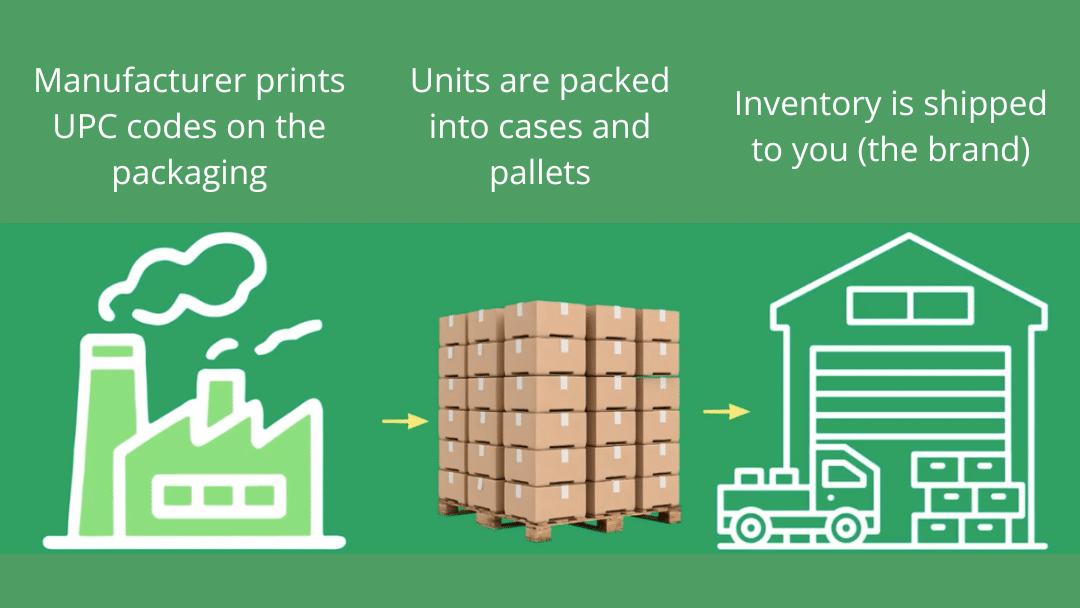
Image above: With GS1 UPCs, the same barcode stays on the product throughout the entire supply chain.
Annotations suggested: arrows showing manufacturer → warehouse → Amazon/Walmart.
If You Want to Sell on Walmart or Other Marketplaces
This is the biggest reason most established brands should avoid GTIN exemptions.
With GS1 UPCs, your supply chain is simple:
- The manufacturer prints one universal barcode on every unit
- Units are packed into cases (10, 24, etc.)
- Cases are shipped to your warehouse
- Those same cases can be sent to Amazon, Walmart, physical retail, or distributors
No relabeling. No repacking. The same barcode works everywhere.
With a GTIN exemption, everything gets more complicated:
- The manufacturer produces units with no barcode
- Inventory arrives at your warehouse unmarked
- If you want to send units to Amazon FBA:
- Open every case
- Pull out every unit
- Apply Amazon FNSKU labels one by one
- Repack the cases
- If you want to send units to Walmart:
- Repeat the entire process
- Using Walmart’s internal barcode instead
Now you’re managing platform-specific barcodes instead of one universal barcode.
That creates:
- More labor and higher warehouse costs
- Longer prep times and replenishment delays
- More opportunities for barcode mix-ups
And barcode mix-ups are not theoretical. When they happen, customers receive the wrong product, Amazon keeps sending replacements that are also wrong, listings get shut down, inventory gets returned, and you’re paying shipping and labor costs the entire time while losing sales and reviews.
For most brands using FBA, 3PLs, or multiple marketplaces, this adds a massive amount of unnecessary complexity.
The One Exception: FBM From the Manufacturer
If you are shipping FBM directly from the manufacturing location, the problem above disappears.
- You’re not swapping one barcode for multiple barcodes
- You’re substituting one barcode for no barcode
That’s a much cleaner tradeoff. This is why GTIN exemptions only make sense in specific fulfillment scenarios.
Deciding between FBA vs FBM? We have an article about that.
If You Ever Want to Switch to GS1 UPCs Later
ASINs created under a GTIN exemption cannot be converted to use UPCs later.
- You must create brand-new listings
- You lose reviews
- You lose search ranking
- You lose sales history
Other Situations Where GTIN Exemptions Usually Don’t Make Sense
If you bought third-party UPC codes in the past: In most cases, buying new official GS1 UPCs registered under your brand name is the better fix.
Private label sellers just getting started: Especially if you plan to use FBA, GS1 UPCs usually provide more flexibility long term.
If you want to sell in physical retail: Physical retail stores almost always require UPCs.
A Quick Note on Search Rankings
You may see claims online that GTIN exemptions hurt Amazon search visibility.
What those articles usually mean is:
- Listing products as “Generic” hurts visibility
- Not that GTIN exemptions themselves do
I agree that listing products as Generic is usually a bad idea. But don’t use UPCs just because you think they’ll magically improve rankings — I haven’t seen evidence of that.
When a GTIN Exemption DOES Make Sense
Print-on-Demand, Custom, or Handmade Products
- High variation counts
- Constantly changing designs
- Direct-to-customer fulfillment
In these situations, GTIN exemptions are a great fit.
Clothing & Apparel With Large Variation Counts
Buying UPCs for hundreds or thousands of size/style combinations can be extremely expensive. GTIN exemptions are very common here.
Mechanical Parts or Highly Fragmented Catalogs
GTIN exemptions work well for large, low-priced catalogs, especially if you’re not using FBA.
GTIN Exemption vs GS1 UPCs: Pros and Cons
GTIN Exemption — Benefits
- Free
- Approval is relatively fast (usually 2–4 business days)
- Ideal for large or rapidly changing catalogs
- Works well for FBM or direct-ship scenarios
GTIN Exemption — Drawbacks
- Listings can’t be converted to UPCs later
- Benefits shrink significantly if you use FBA
- Creates platform-specific barcodes
- Complicates multi-channel inventory management
Quick Decision Tables (So You Don’t Regret This Later)
If you’re trying to decide whether a GTIN exemption is worth it, these tables summarize the decision points and the tradeoffs. The goal here is not to oversimplify it — it’s to make sure you don’t accidentally pick the option that forces you to rebuild listings later.
Should you get a GTIN exemption?
| Situation | GTIN Exemption Usually Makes Sense? | Why |
|---|---|---|
| Print-on-demand / custom / handmade (lots of one-off variations) | Yes | Barcoding every variation is impractical, and you’re often shipping direct-to-customer anyway. |
| Apparel with huge variation counts (styles × sizes) | Often | UPC costs add up fast when you need hundreds or thousands of codes. |
| Mechanical parts / fragmented catalogs | Often | UPCs often aren’t used traditionally; exemptions reduce friction (especially outside FBA). |
| You already have UPCs printed on product/packaging | No | Amazon will reject the exemption if a barcode is visible, and you don’t need it anyway. |
| You plan to sell on Walmart / other channels / retail | No | Platform-specific labeling creates labor, errors, and extra cost vs one universal GS1 barcode. |
| You’re using FBA and want the simplest supply chain | Usually no | Exemptions often add complexity compared to keeping a universal UPC through the supply chain. |
| You might want to switch to GS1 UPCs later | No | ASINs created under exemption can’t be converted; switching later usually means starting over. |
| You bought reseller UPCs years ago and they don’t match your brand | Depends | Often better to replace them with official GS1 UPCs than build on exemptions. |
GTIN exemption vs GS1 UPCs
| Factor | GTIN Exemption | GS1 UPCs |
|---|---|---|
| Cost | Free | Paid (per code) |
| Approval / time | Requires application + review | No exemption application |
| Best for | Custom items, apparel, fast-changing catalogs | Brands planning to scale across channels |
| Multi-channel flexibility | Low | High |
| Ability to change later | Very limited | Flexible |
How this affects your supply chain
| Step | With GS1 UPCs | With GTIN Exemption |
|---|---|---|
| Manufacturer | Prints one universal barcode | Produces inventory with no universal barcode |
| Warehouse handling | Cases stay intact | Cases are opened and units labeled per platform |
| Amazon / other channels | Same barcode everywhere | Different barcode for each platform |
| Error risk | Lower | Higher |
Quick decision flow
- Do your products already have UPCs printed?
Yes: don’t do a GTIN exemption.
No: continue. - Are you planning Walmart, retail, or distributors?
Yes: buy GS1 UPCs.
No: continue. - Are you custom, print-on-demand, apparel with huge variation counts, or a fragmented parts catalog?
Yes: a GTIN exemption may make sense.
No: GS1 UPCs are usually safer long term.
Step-by-Step: How to Apply for a GTIN Exemption
- Go to Manage All Inventory
- Click Add a Product
- Choose Blank Form
- Enter the item name
- Confirm or select the correct category
- Enter the brand name
- Check “This product does not have a Product ID”
You’ll see:
- Brand Name Approval Required (if applicable)
- UPC Exemption Required
Click Apply to Sell to open the application.
Important: Do Not Use “Generic”
I don’t recommend listing products as Generic. It creates long-term brand problems and is difficult to reverse.
Photo Requirements (Where Most Rejections Happen)
Your photos must:
- Be completely unedited
- Show the actual product and packaging
- Show all sides
- Clearly display the brand name
- Show no barcodes anywhere
The brand name must be permanently printed and must match exactly.
Approval Timeline and Rejections
- Typical approval: 2–4 business days
- Status can be checked under Catalog → Selling Applications
Final Takeaway
GTIN exemptions are a useful tool — but only in the right situations.
If you plan to scale, want multi-channel flexibility, use FBA, or might sell in retail, GS1 UPCs are usually the safer long-term choice.
If you ship FBM, sell custom or print-on-demand products, or have massive variation counts, a GTIN exemption can make a lot of sense.
If you want a walkthrough, the video above covers this step-by-step. If you’ve got a quick question, leave a comment on the video. And if your situation is more complex and you want professional help, reach out to us at customerservice@fivestarcommerce.com or use the “Schedule info call” button on our website.
Trackbacks/Pingbacks