
Last updated April 2026.
Amazon List Price vs Typical Price vs Sale Price (2026 Update)
Amazon has made some important changes to how pricing works—especially around Typical Price.
If you’re trying to show strikethrough pricing, run deals, or maintain margin while still looking competitive, this stuff matters more than ever.
This guide breaks down:
- What List Price and Typical Price actually mean
- How Amazon validates them
- What changed in 2026
- And how to avoid accidentally killing your own discounts
The 3 Prices That Matter on Amazon
On most listings, Amazon is trying to show customers:
- List Price (MSRP)
- Typical Price (Was Price)
- Current Price (your offer price)
These work together to create perceived savings.
If any of them are invalid—or calculated differently than you expect—you lose that strikethrough pricing.
List Price (MSRP)
What it is
List Price is the manufacturer’s suggested retail price.
This is the classic:
“Was $49.99 → Now $34.99”
How Amazon validates it
Amazon doesn’t just take your word for it anymore.
To show a List Price, it must be validated by:
- Recent sales at that price (on Amazon)
- Or matching prices at other retailers
- And it must appear in the last ~90 days
If customers haven’t actually seen or paid that price recently, Amazon won’t use it as a reference price.
Key takeaway
You can’t just upload a high MSRP and expect it to stick.
It needs to reflect real pricing behavior, not just positioning.

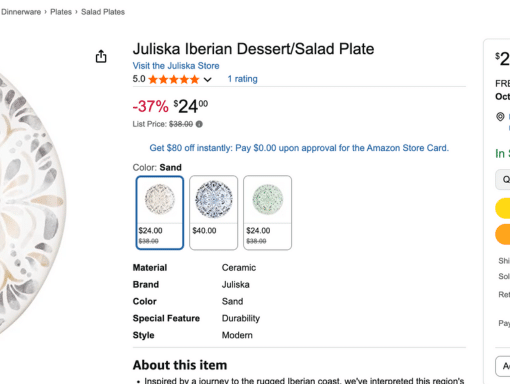
This image shows a sales price with a strikethrough. This only happens if there is a validated reference price.
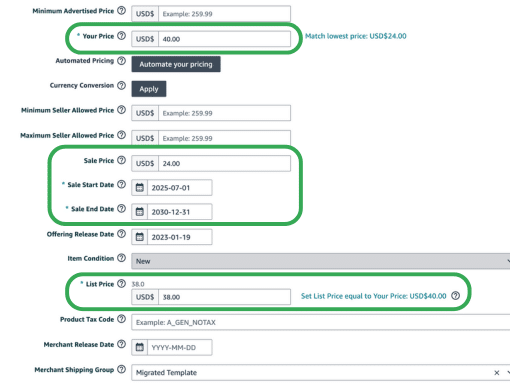
To input these prices, you go to "edit listing" from the "manage all inventory" page and go to the "offer" tab.
Typical Price (This is Where Things Changed)
What it is
Typical Price is the median price customers actually paid over the last 90 days.
This is what Amazon uses when there’s no valid List Price—or alongside it.
🔥 2026 Update: How Typical Price Now Works
This is the big change.
Historically:
- Amazon mostly excluded promotional prices
- So your “normal price” stayed intact even if you ran sales
Now (starting May 18, 2026):
👉 If your product is discounted for more than half of the last 90 days,
Amazon will include ALL prices (including promotional prices) in the Typical Price calculation
What this means in practice
If you run a discount too often…
Your “sale price” becomes your “normal price.” This is where sellers may get surprised because they don't realize they're doing it.
And once that happens:
- Your strikethrough disappears
- Your perceived discount shrinks
- Your deals may stop qualifying
🔥 2026 Update: This Is Where Things Changed
Amazon recently changed how Typical Price (Was Price) works.
Before:
- Promotional prices were mostly ignored
Now:
- If your product is discounted for more than half of the last 90 days
- Amazon may include those lower prices in the calculation
What that means:
If you run a discount too often, your “sale price” can become your “normal price.”
And once that happens:
- Your strikethrough pricing disappears
- Your discounts look smaller (or don’t show at all)
- Your deals may stop qualifying
Simple rule:
Don’t run the same discount for ~45+ days straight.
Keep promos shorter, and let your product return to full price regularly.
⚠️ Rule of Thumb: Don’t Run Sales Too Long
You have a 90-day window.
If your price is discounted for more than ~45 days:
- Amazon treats that as the “real” price
This is why you may not want to run the sale sale for 60+ days straight.
Practical guidance:
- Keep sales under ~30–40 days
- Rotate promos instead of running one long continuous discount
- Let your product return to its “true” price regularly
What Counts (and Doesn’t Count) Toward Typical Price
Amazon now clearly separates different types of pricing.
✅ These are excluded (safe to use)
- Subscribe & Save
- Tailored coupons
- Buy X Get Y promotions
- Peak events (like Prime Day)
These do NOT impact Typical Price.
⚠️ These can affect Typical Price
- Standard price drops
- Long-running discounts
- “Silent” discounts (not labeled as promos)
Also important:
👉 Discounts that are not clearly presented as promotions may be treated as normal pricing and included in Typical Price
Why Amazon Made This Change
Amazon is trying to fix fake discounts.
Before:
- Sellers could run constant “sales”
- And still show big strikethrough pricing (although in reality they've been operating like this for a long time, even though they hadn't announced the official policy).
Now:
- Pricing has to reflect what customers actually pay most of the time
This makes pricing more honest. It's harder to game the system with fake discounts—which is exactly what Amazon is trying to stop.
How This Affects Your Strategy
1. You can’t run permanent “sales” anymore
If you do:
- Your discount becomes your baseline
- And you lose the ability to show savings
2. Promo structure matters more than ever
Instead of:
- One long 60-day sale
Do:
- Shorter promos
- Breaks between discounts
- Mix in coupons and S&S (which are excluded)
3. This actually helps brands with MAP
If you enforce MAP:
- Competitors can’t run constant fake discounts
- Because it will reset their Typical Price
So this change levels the playing field.
4. Your price history now matters even more now
Amazon is aligning:
- Typical Price
- List Price validation
- Deal eligibility
All around actual pricing history
If your graph looks messy, your pricing will be too.
Common Mistakes to Avoid
❌ Running continuous discounts
Leads to your sale price becoming your normal price
❌ Using only price drops instead of structured promos
Non-promotional discounts may count as real pricing
❌ Ignoring the 90-day window
Everything is based on that rolling period
❌ Setting unrealistic List Prices
If it doesn’t match real sales or market pricing, it won’t show
One More Important Note
Amazon updates both List Price and Typical Price constantly. So don't assume it'll stay the same.
That means:
- They can change without notice
- Based on sales, competitors, or pricing history
So this isn’t something you set once and forget.
Final Takeaway
The biggest shift is this: Amazon doesn't care what you say your product is worth—it cares what your actual pricing history proves.
If you remember one thing:
👉 Discount duration matters just as much as discount depth.
Run smarter promos—not longer ones.
Q: What is the difference between List Price and Typical Price?
A: List Price is the MSRP (what the product is “supposed” to sell for).
Typical Price is what customers have actually paid over the last 90 days.
If List Price isn’t valid, Amazon will rely more heavily on Typical Price.
Q: Why did my strikethrough price disappear?
A: Usually one of these happened:
- Your List Price wasn’t validated (no recent sales or matching retailer price)
- Your Typical Price dropped because you ran too many discounts
- Your current price isn’t low enough compared to the reference price
Q: How long can I run a sale before it affects Typical Price?
A: There’s no exact number published, but:
- The window is 90 days
- The threshold is more than half of that
👉 So once you get close to 45+ days of discounted pricing, you’re at risk.
Safe rule: keep promos under ~30–40 days.
Q: Do coupons affect Typical Price?
A: No. Coupons (especially tailored coupons)
Subscribe & Save
Buy X Get Y
These are excluded and won’t impact your Typical Price.
But standard price drops or long-running discounts can affect it—especially if they run for a large portion of the last 90 days.
Q: Do Prime Day or peak event discounts affect Typical Price?
A: No. Amazon specifically excludes peak event pricing (like Prime Day) from Typical Price calculations.
Q: What types of discounts DO affect Typical Price?
A: These can impact it:
- Standard price drops
- Long-running sales
- Discounts that aren’t clearly labeled as promotions
If customers consistently buy at a lower price, Amazon may treat that as the “real” price.
Q: Can my sale price become my normal price?
A: Yes—and this is the biggest change.
If your product is discounted for more than half of the last 90 days, Amazon may:
👉 Treat that lower price as the Typical Price
Which means:
- You lose visible discounts
- Your deals may stop qualifying
Q: How is Typical Price actually calculated?
A: It’s the median price customers paid over the last 90 days.
Depending on your pricing behavior, Amazon will use:
- Only non-promotional sales
or - All sales (including promotional)
If a product is discounted for more than half of the last 90 days, Amazon may include those discounted prices in the calculation.
Q: How do I keep my strikethrough pricing?
A:
- Don’t run continuous discounts
- Let your product return to full price regularly
- Keep your List Price realistic and validated
- Use coupons or S&S for longer-term incentives (since they’re excluded
Q: Does Amazon notify you before changing your List Price or Typical Price?
A: No.
Both are dynamic and can change at any time based on:
-
- Sales history
- Competitor pricing
- Your own pricing behavior
Q: Does this change help or hurt brands?
A: It generally helps brands, especially those enforcing MAP.
Why:
- Competitors can’t run fake, constant discounts anymore
- Long-term discounting resets their own pricing baseline