You’ve already enrolled your product in Amazon Vine. The reviews are starting to come in, and some of them are not very good.
At this point, there’s no reason to debate whether you should have used Vine in the first place. You already did it. The useful question now is: How bad is the situation actually, and what should you do next?
I’ve dealt with this situation many times, and in most cases the brand is more worried than it needs to be. A few mediocre or negative Vine reviews do not automatically mean the listing is ruined. You need to look at the overall pattern, understand how Vine reviewers behave, determine whether the complaints are fixable, and then decide whether you should keep the enrollment going, stop the remaining units, or—in a genuinely bad situation—start over with a new listing.
If you’re still evaluating the program itself rather than dealing with reviews that are already coming in, I have a separate guide on whether Amazon Vine is worth it for sellers.
First, Don’t Expect Every Vine Review to Be Five Stars
One of the biggest mistakes brands make is assuming that a successful Vine enrollment should result in 30 glowing five-star reviews.
That’s just not realistic.
Vine reviewers tend to take the review process seriously. They were selected for the program because they write useful, detailed reviews, and a lot of them review many products in similar categories. That means they frequently know what to look for and have more points of comparison than the average customer.
In my experience, they’re also a little pickier than normal customers.
A Vine reviewer can like the product, think it works exactly as intended, and still give it four stars because they think the price is a little high. I’ve seen that many times with more expensive products.
That always makes me laugh a little because, of course, the Vine reviewer didn’t actually pay for the product. But they aren’t necessarily evaluating it from the perspective of, “I received this for free, so this is great.” They see themselves as helping future customers make a buying decision, so they think about what someone else would have to pay.
A lot of them seem to treat four stars as their default for a good product and feel like the product has to do something exceptional to earn the fifth star.
So if somebody writes a long, thoughtful review, explains what they liked, maybe mentions one small limitation, and gives you four stars, I would consider that a perfectly good Vine review.
I would not be worried about it.
And if most of the Vine reviews are four or five stars, then one random two-star or three-star review isn’t automatically a problem either. Real customers are not going to give you nothing but five-star reviews later.
You need to experience what customers actually think about the product. Vine is one way of getting that information early.
Review Count Can Matter More Than a Perfect Star Rating
I was at an Amazon conference a while back where one of the people on a panel from Amazon shared something from Amazon’s internal data that I thought was interesting.
According to what was shared at that conference, the number of reviews mattered more to customers than the exact star rating or even what individual reviews said, and roughly 27 reviews was the point where a product started to have meaningful social proof.
I would treat that as an anecdote from the conference rather than some official published Amazon rule, but it lines up with what I’ve seen.
This is why brands sometimes overreact when Vine takes a product from a perfect 5.0 to something like a 4.3 or 4.4.
I would generally rather have a product with a 4.3 rating and 30 or 50 reviews than a product showing a perfect five stars with only three reviews.
Three five-star reviews still looks like a brand-new product. Customers don’t have much information yet.
Thirty or 50 reviews gives shoppers a much bigger pool of customer feedback. It looks more established, even though a few people weren’t completely happy.
And remember that as regular customers start purchasing the product, you’re going to get some four-star, three-star, and occasionally lower reviews anyway. A permanent perfect 5.0 is not a realistic goal for most products.
The goal is not to protect a mathematically perfect rating forever. The goal is to have enough positive customer experiences that the product maintains a strong overall reputation and continues selling.
Vine Reviews Can Behave Differently in Amazon’s Star-Rating Calculation
There’s another reason I usually don’t panic when a product starts with some less-than-perfect Vine reviews.
In my experience, Vine reviews can have relatively little influence on the displayed star rating once you start receiving regular verified-purchase reviews.
I once saw a product that had around 10 five-star Vine reviews. Everything looked great.
Then it received a single one-star verified-purchase review from an actual customer, and the displayed rating dropped dramatically—down around two stars.
That was obviously terrible for that particular product, because the regular customer happened to be the one leaving the negative review. But it demonstrated something useful: that verified-purchase review appeared to carry dramatically more influence on the displayed rating than all those Vine reviews.
Now flip that example around.
Suppose your Vine reviewers average 3.8 or 4.0, but the people who actually buy the product with their own money tend to rate it around 4.6 or 4.7.
That is a much better situation.
Real customers have already looked at your listing, looked at the price, thought about whether the product applies to them, and then decided to spend their own money on it. In other words, they’ve filtered themselves into the target audience much more effectively than a Vine Voice who selected a free product from a Vine portal.
So a somewhat picky group of Vine reviewers is not necessarily a forecast of what your long-term rating will be.
When I Would Actually Start Worrying About Vine Reviews
The pattern matters much more than one review.
If most of your Vine reviews are four or five stars and you occasionally get a one, two, or three, I generally wouldn’t be concerned.
If the overall pattern starts coming in around three stars or below, now you have something to investigate.
There’s also a difference between the individual review pattern and your displayed star rating. As a practical rule, once a product gets down into roughly the high-3-star range—around 3.7 to 3.8—it can become materially harder to sell in many categories.
That does not mean every product below 3.8 is doomed. Category norms matter.
There are categories where customers routinely leave lower ratings. Non-alcoholic beverages are one example I’ve seen. Pop-on nails can be another. If competing products across the category all have relatively mediocre ratings, then a 3.7 might not look nearly as bad.
But if you’re in a category where nearly every major competitor is sitting around 4.5 stars and you’re at 3.6, that’s a very different situation.
How Worried Should You Be?
| What You’re Seeing | How I’d Read It | What I’d Do |
|---|---|---|
| Mostly 4- and 5-star reviews | Normal. Vine reviewers tend to be a little pickier than regular customers. | Keep going. Don’t overreact to a few less-than-perfect reviews. |
| Mostly 4- and 5-star reviews with one 2- or 3-star review | Usually not a big concern by itself. | Read the review for anything useful, but focus on the overall pattern. |
| Several reviewers mentioning the same misunderstanding | Probably a listing or expectation-setting problem. | Improve images, instructions, sizing, compatibility details, ingredients, or other product information. |
| Several reviewers mentioning the same defect | More likely a product, packaging, or quality-control problem. | Fix the underlying issue before sending more inventory. |
| General review pattern is around 3 stars or below | Now I’d be concerned. | Investigate the repeated complaints and decide whether remaining Vine enrollment should continue. |
| Displayed rating is in the high-3-star range and sales are struggling | Recovery can become much more difficult in many categories. | Fix the listing or product, earn legitimate customer reviews, and evaluate whether the ASIN can recover. |
| Poor rating, little sales traction, and a serious underlying product problem | This is where a relaunch may become worth considering. | Compare the cost of recovering the ASIN against the cost and complexity of starting over. |
The main thing is that one ugly review is not the same thing as a bad review pattern. I care much more about repeated complaints than one Vine Voice who simply didn’t like the product.
Check How Many Vine Units Have Actually Been Claimed
Before deciding whether to stop Vine, go into the Vine dashboard and look at the numbers for enrolled and claimed units.
The screenshot below is the part of the dashboard I’m talking about.
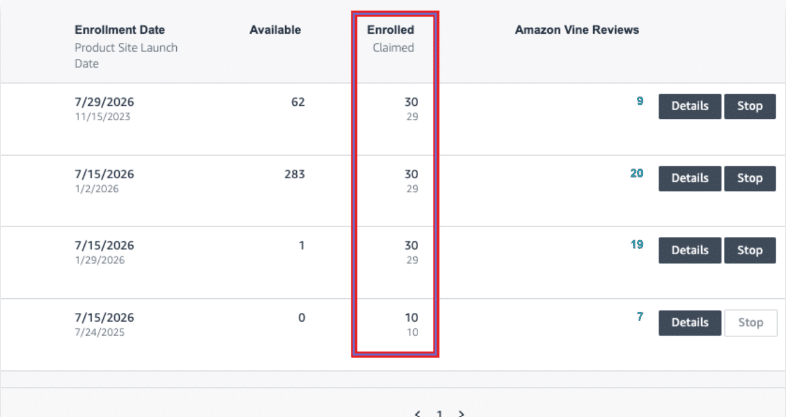
Image above: The Vine dashboard shows how many units were enrolled and how many have already been claimed. Stopping Vine only affects units that have not yet been claimed.
Understand the Difference Between Enrolled Units and Claimed Units
An enrolled unit is a unit you made available through the Vine program.
A claimed unit is one a Vine Voice has already selected. Once somebody claims the product, Amazon sends it to them so they can review it.
If all your units have already been claimed, there isn’t much benefit in stopping Vine. Those reviewers already have—or will receive—the products.
Stopping the enrollment at that point does not call those products back and does not prevent those people from reviewing them.
If only part of your enrollment has been claimed, you have a real decision to make.
Suppose you enrolled 30 units but only 10 have been claimed. If the first group of reviews reveals a major problem and you’re confident you don’t want another 20 Vine reviewers receiving the product, stopping the enrollment can prevent the remaining units from being claimed.
It does not erase the first 10.
Those reviews can still come through.
That’s why the Enrolled and Claimed numbers in the dashboard matter. Amazon’s Vine FAQ also distinguishes between cancelling an enrollment before anything is claimed and stopping an enrollment after at least one unit has been claimed.
A Negative Vine Review Usually Can’t Just Be Removed
This is one of the first questions brands ask me: Can we just get the bad review taken down?
Usually, no.
Amazon allows sellers to report a review that violates its Community Guidelines. That is different from asking Amazon to remove a legitimate review simply because you don’t like the rating.
For example, if somebody includes private information, prohibited content, or something else that clearly violates the rules, you can report it. Amazon’s Customer Reviews tools also provide a path for reporting reviews that don’t follow the guidelines.
But Vine reviewers usually understand Amazon’s review rules pretty well. They write a lot of reviews and know how the system works.
So a Vine reviewer saying, “The product was too expensive for what I received,” or, “I didn’t like how this tasted,” generally isn’t going to disappear because the seller disagrees with it.
I very rarely see Amazon remove legitimate product reviews just because they’re negative.
There are third-party services that focus on identifying reviews that might qualify for removal. Even then, expectations need to be realistic. My prep notes estimate that perhaps around 10% of negative reviews may even be plausible targets in some situations, with the portion actually removed potentially closer to 5%. It can take several months, and the reviews you most want removed may not be the ones that qualify.
So for most sellers, trying to delete legitimate criticism is not the strategy.
A better strategy is to understand the criticism, fix whatever you can, and begin collecting legitimate feedback from customers who actually choose to buy the product.
Three Ways to Start Earning More Reviews Outside Vine
If the Vine reviews are mediocre but you still believe the product is good, the next objective is to start earning normal customer reviews so the Vine reviews become a smaller part of the overall picture.
The first tactic is using Amazon’s review-request process after orders. You can do this manually, but software can automate it.
Sellerboard is one option I use with a lot of clients. In addition to review requests, it includes things such as profit analytics, inventory tools, PPC tools, and listing-change alerts.
When the video was recorded, I referenced it at about $20 per month, with a 30-day free trial and a referral offer that extended the trial to 60 days. The newer screenshot below shows plans starting at $15 per month with a one-month free trial. Software pricing and promotions change, so verify the current offer before publishing.

Image above: sellerboard includes automated review requests alongside profit analytics, inventory, PPC, and listing-monitoring tools.
You’ve already enrolled your product in Amazon Vine. The reviews are starting to come in, and some of them are not very good.
At this point, there’s no reason to debate whether you should have used Vine in the first place. You already did it. The useful question now is: How bad is the situation actually, and what should you do next?
I’ve dealt with this situation many times, and in most cases the brand is more worried than it needs to be. A few mediocre or negative Vine reviews do not automatically mean the listing is ruined. You need to look at the overall pattern, understand how Vine reviewers behave, determine whether the complaints are fixable, and then decide whether you should keep the enrollment going, stop the remaining units, or—in a genuinely bad situation—start over with a new listing.
If you’re still evaluating the program itself rather than dealing with reviews that are already coming in, I have a separate guide on whether Amazon Vine is worth it for sellers.
First, Don’t Expect Every Vine Review to Be Five Stars
One of the biggest mistakes brands make is assuming that a successful Vine enrollment should result in 30 glowing five-star reviews.
That’s just not realistic.
Vine reviewers tend to take the review process seriously. They were selected for the program because they write useful, detailed reviews, and a lot of them review many products in similar categories. That means they frequently know what to look for and have more points of comparison than the average customer.
In my experience, they’re also a little pickier than normal customers.
A Vine reviewer can like the product, think it works exactly as intended, and still give it four stars because they think the price is a little high. I’ve seen that many times with more expensive products.
That always makes me laugh a little because, of course, the Vine reviewer didn’t actually pay for the product. But they aren’t necessarily evaluating it from the perspective of, “I received this for free, so this is great.” They see themselves as helping future customers make a buying decision, so they think about what someone else would have to pay.
A lot of them seem to treat four stars as their default for a good product and feel like the product has to do something exceptional to earn the fifth star.
So if somebody writes a long, thoughtful review, explains what they liked, maybe mentions one small limitation, and gives you four stars, I would consider that a perfectly good Vine review.
I would not be worried about it.
And if most of the Vine reviews are four or five stars, then one random two-star or three-star review isn’t automatically a problem either. Real customers are not going to give you nothing but five-star reviews later.
You need to experience what customers actually think about the product. Vine is one way of getting that information early.
Review Count Can Matter More Than a Perfect Star Rating
I was at an Amazon conference a while back where one of the people on a panel from Amazon shared something from Amazon’s internal data that I thought was interesting.
According to what was shared at that conference, the number of reviews mattered more to customers than the exact star rating or even what individual reviews said, and roughly 27 reviews was the point where a product started to have meaningful social proof.
I would treat that as an anecdote from the conference rather than some official published Amazon rule, but it lines up with what I’ve seen.
This is why brands sometimes overreact when Vine takes a product from a perfect 5.0 to something like a 4.3 or 4.4.
I would generally rather have a product with a 4.3 rating and 30 or 50 reviews than a product showing a perfect five stars with only three reviews.
Three five-star reviews still looks like a brand-new product. Customers don’t have much information yet.
Thirty or 50 reviews gives shoppers a much bigger pool of customer feedback. It looks more established, even though a few people weren’t completely happy.
And remember that as regular customers start purchasing the product, you’re going to get some four-star, three-star, and occasionally lower reviews anyway. A permanent perfect 5.0 is not a realistic goal for most products.
The goal is not to protect a mathematically perfect rating forever. The goal is to have enough positive customer experiences that the product maintains a strong overall reputation and continues selling.
Vine Reviews Can Behave Differently in Amazon’s Star-Rating Calculation
There’s another reason I usually don’t panic when a product starts with some less-than-perfect Vine reviews.
In my experience, Vine reviews can have relatively little influence on the displayed star rating once you start receiving regular verified-purchase reviews.
I once saw a product that had around 10 five-star Vine reviews. Everything looked great.
Then it received a single one-star verified-purchase review from an actual customer, and the displayed rating dropped dramatically—down around two stars.
That was obviously terrible for that particular product, because the regular customer happened to be the one leaving the negative review. But it demonstrated something useful: that verified-purchase review appeared to carry dramatically more influence on the displayed rating than all those Vine reviews.
Now flip that example around.
Suppose your Vine reviewers average 3.8 or 4.0, but the people who actually buy the product with their own money tend to rate it around 4.6 or 4.7.
That is a much better situation.
Real customers have already looked at your listing, looked at the price, thought about whether the product applies to them, and then decided to spend their own money on it. In other words, they’ve filtered themselves into the target audience much more effectively than a Vine Voice who selected a free product from a Vine portal.
So a somewhat picky group of Vine reviewers is not necessarily a forecast of what your long-term rating will be.
When I Would Actually Start Worrying About Vine Reviews
The pattern matters much more than one review.
If most of your Vine reviews are four or five stars and you occasionally get a one, two, or three, I generally wouldn’t be concerned.
If the overall pattern starts coming in around three stars or below, now you have something to investigate.
There’s also a difference between the individual review pattern and your displayed star rating. As a practical rule, once a product gets down into roughly the high-3-star range—around 3.7 to 3.8—it can become materially harder to sell in many categories.
That does not mean every product below 3.8 is doomed. Category norms matter.
There are categories where customers routinely leave lower ratings. Non-alcoholic beverages are one example I’ve seen. Pop-on nails can be another. If competing products across the category all have relatively mediocre ratings, then a 3.7 might not look nearly as bad.
But if you’re in a category where nearly every major competitor is sitting around 4.5 stars and you’re at 3.6, that’s a very different situation.
How Worried Should You Be?
| What You’re Seeing | How I’d Read It | What I’d Do |
|---|---|---|
| Mostly 4- and 5-star reviews | Normal. Vine reviewers tend to be a little pickier than regular customers. | Keep going. Don’t overreact to a few less-than-perfect reviews. |
| Mostly 4- and 5-star reviews with one 2- or 3-star review | Usually not a big concern by itself. | Read the review for anything useful, but focus on the overall pattern. |
| Several reviewers mentioning the same misunderstanding | Probably a listing or expectation-setting problem. | Improve images, instructions, sizing, compatibility details, ingredients, or other product information. |
| Several reviewers mentioning the same defect | More likely a product, packaging, or quality-control problem. | Fix the underlying issue before sending more inventory. |
| General review pattern is around 3 stars or below | Now I’d be concerned. | Investigate the repeated complaints and decide whether remaining Vine enrollment should continue. |
| Displayed rating is in the high-3-star range and sales are struggling | Recovery can become much more difficult in many categories. | Fix the listing or product, earn legitimate customer reviews, and evaluate whether the ASIN can recover. |
| Poor rating, little sales traction, and a serious underlying product problem | This is where a relaunch may become worth considering. | Compare the cost of recovering the ASIN against the cost and complexity of starting over. |
The main thing is that one ugly review is not the same thing as a bad review pattern. I care much more about repeated complaints than one Vine Voice who simply didn’t like the product.
Check How Many Vine Units Have Actually Been Claimed
Before deciding whether to stop Vine, go into the Vine dashboard and look at the numbers for enrolled and claimed units.
The screenshot below is the part of the dashboard I’m talking about.
Ways to Earn More Reviews After Vine
| Method | How It Works | Important Limitation |
|---|---|---|
| Automated Amazon review requests | Software can trigger Amazon’s review request after customer orders. | It does not guarantee that the customer will leave a review. |
| Product card inserts | Include a compliant review reminder inside the physical product. | With existing FBA inventory, you normally can’t add the insert until a future batch. |
| Existing customer base | Tell legitimate existing customers that your product is now available on Amazon and ask for support in a policy-compliant way. | Do not manufacture reviews or ask people with a prohibited personal or financial connection to review the product. |
| Normal customer sales | Continue selling and allow genuine buyers to review naturally. | This can take time, particularly if a weak rating is hurting conversion. |
Product Card Inserts
The second tactic is including a card insert with the product that reminds customers they can leave an honest review.
With FBA, the insert needs to be packed with the product before you send the inventory to Amazon. So this usually isn’t something you can immediately add to the units already sitting in FBA.
But you can add it to your next production batch.
The request needs to stay neutral. Don’t ask specifically for a five-star review, don’t offer something in exchange for the review, and don’t create one process for happy customers and another for unhappy customers.
Your Existing Customer Base
If your brand already has customers outside Amazon, you may also be able to tell them that you’re now selling on Amazon and ask them to support the launch in a policy-compliant way.
The key word there is legitimate.
This is not permission to manufacture reviews from friends, relatives, employees, business associates, or other people with a personal or financial connection to the brand.
Don’t Try to Manufacture Reviews From Friends and Family
Amazon does not allow sellers to have friends or family buy a product specifically so they can leave reviews.
Some sellers assume there are ways Amazon won’t connect the relationship—for example, because a friend or relative lives somewhere else.
That is not something I would build a strategy around.
Amazon can identify unusual review patterns.
If a newly launched product suddenly has an abnormally high percentage of buyers leaving reviews, particularly if there are relationships or other suspicious signals around those buyers, the reviews may be blocked or the account can attract unwanted attention.
The source material describes several things sellers have seen happen. A specific customer may lose the ability to post the review. Amazon may temporarily prevent reviews from appearing on the product. The seller might receive a warning stating that Amazon suspects manipulation. Or the review might appear to submit normally and simply never show up on the detail page.
Amazon’s current review policies also prohibit reviews involving certain personal or financial conflicts and compensated or incentivized reviews.
Be Careful With Large Discounts If You’re Hoping for Reviews
The same issue applies to heavily discounted purchases.
If you give somebody a huge promotion code so they can buy the product cheaply and then review it, there is a greater chance that the resulting review will not stick.
The script uses the example of a small 10% or 20% promotion potentially looking very different from a 50%, 60%, or 80% discount.
Once you start giving the product away at an enormous discount, Amazon knows the customer did not pay anything close to the normal market price.
Discounting can absolutely be useful for generating sales traction. That is a separate question.
But don’t confuse a launch discount with a guaranteed method of generating permanent reviews, and never make a discount or other benefit contingent on leaving a review.
The Best Way to Prevent More Negative Reviews Is to Fix Customer Expectations
A surprising percentage of negative reviews do not mean the product itself is terrible.
They mean there was a mismatch between what the person expected and what they actually received.
That is often fixable.
If you keep seeing the same misunderstanding in reviews, you should not just complain that customers aren’t reading the listing carefully enough.
Amazon customers skim.
That’s normal.
Your job is to make the most important information almost impossible to miss. This is also why good Amazon listing images matter so much. Size, ingredients, compatibility, what’s included, and other important buying information can often be communicated more effectively in the images than buried in text.
Common Negative Review Problems and What to Fix
| Negative Review Complaint | Likely Problem | What to Change |
|---|---|---|
| “It was smaller than I expected.” | Size information wasn’t obvious enough. | Add dimensions to images, use comparison photos, and include a clear sizing chart when applicable. |
| “It looked different from the photos.” | Listing images created the wrong expectation. | Use more realistic photography, additional angles, and scale comparisons. |
| “I couldn’t figure out how to use it.” | Instructions are unclear or incomplete. | Improve listing instructions and include physical instructions with the product. |
| “It doesn’t work with my device.” | Compatibility information was too easy to miss. | Put compatibility and incompatibility directly in the listing images and text. |
| “I didn’t realize it contained this ingredient.” | Important ingredient information was buried. | Show ingredients, Supplement Facts, or Nutrition Facts in the listing images. |
| “The product burned, stung, or felt unusual.” | The customer wasn’t prepared for a normal product characteristic. | Explain the sensation in advance and, when appropriate, explain why it happens. |
| “It arrived broken.” | Packaging or fulfillment preparation may be inadequate. | Improve the packaging before sending additional inventory to FBA. |
| “I received the wrong product.” | There may be an inventory, labeling, or FBA issue. | Investigate FBA inventory and make sure the units and labels are correct. |
| “It costs too much.” | The reviewer may not understand the premium benefit—or the price may actually be too high. | Make the premium value obvious and compare the complaint with what paying customers say. |
| Multiple reviewers report the same defect | Likely a real product-quality problem. | Fix the product itself rather than trying to solve it through listing copy. |
Make the Size Obvious
Suppose a reviewer says, “I thought this would be much bigger.”
If the dimensions were buried in a paragraph halfway down the page, you technically gave the customer the information, but you didn’t communicate it very effectively.
Put the dimensions in an image. Show the product next to something familiar for scale. If the product comes in several sizes, create a clear sizing chart and make it easy for customers to figure out which version they need.
Make the Product Images Look Like the Real Product
Another common review is, “This looked completely different than the pictures.”
If the photography or graphics make the product look significantly different from what shows up at the customer’s house, update the images.
The goal is not to make the product look as impressive as possible at any cost. The goal is to make the customer who wants the actual product recognize it before they buy it.
A customer who decides not to purchase because you showed them an accurate limitation is often better than a customer who buys based on the wrong expectation and leaves you a one-star review.
Better Instructions Can Eliminate a Lot of Negative Reviews
I see products all the time where the instructions are not very good.
If the product requires setup, assembly, application, configuration, mixing, charging, pairing, installation, or some other process, the customer needs clear instructions.
Those instructions should usually exist in two places.
They should be explained on the listing so the customer understands what will be required before buying.
They should also physically come with the product so the person has the instructions when they actually use it.
A Vine reviewer is probably not going to call you and ask how something works.
Neither is the average Amazon customer.
They’re much more likely to try it, become frustrated, decide the product is poorly designed, and then explain that frustration in the review.
Compatibility Information Needs to Be Extremely Obvious
Suppose you sell a phone accessory that works with an iPhone 13 but does not work with the iPhone 13 Mini.
Do not bury that distinction in a paragraph.
Make it obvious in the listing text, and more importantly, put it directly into one of the images.
If reviewers keep receiving the product and complaining that it doesn’t work with another device, that is a sign the compatibility information is not prominent enough.
Put Ingredients and Other Important Details in the Images
The same principle applies to products with ingredients.
Don’t rely exclusively on the ingredients field far down the detail page.
For a dietary supplement, food, beverage, cosmetic, or similar product, I generally want important ingredient or nutrition information visible in the listing images.
A lot of the time, that means putting the Supplement Facts, Nutrition Facts, or ingredient information into one of the first few secondary images.
Explain the “Bad” Thing If It’s Actually Part of the Benefit
I worked with a dietary supplement that contained alcohol.
The alcohol served a real purpose. It helped the product absorb into the bloodstream very efficiently.
But it also created a burning sensation.
Imagine buying the product without knowing that.
You take it. It burns. You think something is wrong with the product. Then you leave a terrible review.
The solution was not to hide the burning sensation and hope nobody noticed.
We needed to do the opposite.
We explained that the product contained alcohol, explained why the alcohol was there, explained that the user should expect the burning sensation, and connected that sensation to the reason the formulation worked the way it did.
Now the customer wasn’t surprised.
Even better, the thing that initially sounded like a negative became part of the explanation for why the product was different from alternatives.
Repeated Quality-Control Complaints Are Different
There is an important distinction between a listing problem and a product problem.
If one reviewer says, “I thought this was going to be bigger,” you may have an expectation-setting issue.
If six reviewers say, “Mine arrived broken,” you probably have a physical problem.
If customers are receiving the wrong product, Amazon may have inventory mixed up inside FBA or there may be a labeling problem.
If customers are receiving broken products, the packaging may not be strong enough for FBA handling and shipping.
If several independent reviewers identify the same defect, do not keep sending another 30 units into Vine and hope the next group happens to be nicer.
Fix the product first.
Vine Can Be Especially Difficult for Niche Products
Some products are naturally a poor fit for random Vine reviewers.
Imagine a dietary supplement designed for people with a very particular condition.
The product may work extremely well for that audience.
But a random person who does not have that problem might claim it because it’s free, use it, experience no benefit, and then conclude that it doesn’t work.
In the prep notes, one example is a supplement intended to help people whose hormones are out of balance.
If somebody whose hormones are already fine takes it, they may get no benefit at all. They might even have an unpleasant experience because they were never the target customer.
That does not necessarily mean the product is bad.
It means a general-purpose reviewer was a poor match for a specialized product.
Premium Products Can Also Struggle With Vine
Highly premium products can have a similar problem.
Suppose your product costs significantly more than competitors because it includes one feature that matters enormously to a narrow group of customers.
Those customers understand the value. They actively need that feature. They are happy to pay more because the cheaper products do not solve the same problem.
A Vine reviewer may not belong to that target audience.
They might look at your $100 product, compare it with several $50 products, and leave four or even three stars because they think it is overpriced.
That does not necessarily mean your market positioning is wrong.
At the same time, don’t automatically dismiss price complaints just because they came from Vine. If Vine reviewers complain about the price and your paying customers later say exactly the same thing, then you may have a genuine pricing problem.
Sometimes the Negative Reviews Are Doing You a Favor
If a product has a real defect, you would rather find out early.
Imagine you launch with no reviews and the product is not selling.
You may tell yourself, “It just isn’t selling because we don’t have reviews yet.”
Then you get some Vine reviews and discover that five people independently hate the same feature.
Now you have useful information.
Maybe you need to improve the next manufacturing batch. Maybe you need to change the packaging. Maybe you need better instructions. Maybe you need to lower the price. Maybe your images are attracting the wrong customer. Or maybe the product simply isn’t good enough yet.
If a product cannot get reasonably positive feedback from impartial reviewers because the product itself has major problems, avoiding Vine would not have solved the underlying issue.
Low-Cost and High-Cost Products Have Different Vine Economics
If you sell an inexpensive product, giving away 30 units may not be a huge financial hit.
If you sell a very expensive product, the calculation changes.
Giving away 30 units can represent a meaningful amount of inventory cost. If the product is physically large, you may also have higher FBA fulfillment costs associated with those units.
On the other hand, expensive niche products can sometimes have a harder time earning organic reviews, which makes an early review program more valuable.
There isn’t one answer that applies to every ASIN.
You Can Enroll in Vine Before the Product Is Available to Regular Customers
One strategy some brands use is to get Vine started before the normal customer launch.
You can send inventory into FBA and set a future available date on the listing.
That can allow Vine enrollment to start while regular customers still cannot purchase the product.
The advantage is that you may have some Vine feedback on the listing before regular shoppers start seeing and buying it.
There is still risk, because you do not know what those Vine reviews will say.
Amazon’s Official Vine Requirements Still Matter
The Amazon information in the prep material describes Vine as a program where selected customers—Vine Voices—receive eligible products and provide reviews.
For sellers, the prep material says you need to be a Professional Selling Partner and have the appropriate Brand Representative or Reseller role associated with a brand in Brand Registry.
The product also needs an active FBA listing.
Eligible products generally need fewer than 30 reviews on the product detail page, an image and description, and they cannot be adult or digital products.
If you need more background on the brand side of this, see my guide to what Amazon Brand Registry does and doesn’t do.
You can also check Amazon’s current Vine documentation before enrolling because eligibility rules and fees can change.
Once You Submit the Enrollment, Your Options Become More Limited
Amazon’s enrollment flow is essentially:
- Enter the ASIN and click Begin enrollment.
- Verify the product information.
- For a standalone ASIN, select the number of units you want to enroll, from 1 up to 30.
- For a product family, select the eligible variations you want included.
- Confirm the enrollment.
- Review the fee and program terms.
- Complete the enrollment.
One important part is that after the enrollment is submitted, you generally cannot just go back and freely add or remove variations or adjust the enrolled quantity.
Should You Continue Vine, Stop It, or Relaunch?
| Situation | Continue Vine | Stop Remaining Vine Enrollment | Consider Relaunching |
|---|---|---|---|
| Reviews are mostly 4 or 5 stars | Yes | No | No |
| One isolated negative review | Yes | No | No |
| Negative reviews are based on fixable listing confusion | Usually | Maybe | Usually not |
| Several unclaimed units remain and early reviews reveal a serious problem | Probably not | Yes | Maybe |
| All Vine units have already been claimed | The process is essentially already committed | Stopping won’t prevent claimed units from being reviewed | Only if the overall situation is severe |
| Multiple reviewers report the same product defect | Not until the issue is fixed | Yes, if units remain | Maybe |
| Regular customers are still buying and leaving better reviews | Usually | Usually not | Usually not |
| Rating is very poor, sales have stopped, and the underlying problem was severe | No | Yes, if possible | Yes |
| Existing listing still has meaningful sales traction | Usually | Depends on the remaining Vine risk | Usually not |
When Relaunching Under a New UPC Actually Makes Sense
Relaunching is the drastic option.
Most of the time, I would rather fix the existing listing.
But there are situations where the early reviews are so bad, the displayed rating is so damaging, or the product had such a serious quality-control problem that starting over may make sense.
That generally means creating a genuinely new listing under a different UPC.
You need to understand the operational consequences before doing that.
Once you switch to a new UPC for the Amazon version of that product, you’re creating a long-term barcode-management issue.
Units going into FBA will need the correct barcode associated with the new listing.
If you want more background on why product identifiers can create long-term problems, see my article about GTINs, UPCs, and situations where starting listings the wrong way can force you to start over later.
Existing FBA Inventory Makes a Relaunch More Expensive
Your current FBA inventory does not simply move over to your new ASIN.
You have to decide what to do with it.
You could leave the old listing active and sell through the inventory.
Or you could create a removal order and have Amazon send the units back to you.
If you only have a small quantity in FBA, that may be manageable.
If you have a large amount, the removal fees and logistics can become expensive very quickly.
And it takes time.
In my experience, a removal order may take roughly two to four weeks, sometimes longer, before the units actually make it back to you.
Then the products may need new barcodes, you have to prepare them again, and you have to ship them back into FBA under the new listing.
That is why I would not relaunch a product just because one Vine reviewer gave you two stars.
A New Listing Also Means Losing Your Existing Sales Traction
The barcode logistics are only one cost.
You also lose the history of the old listing.
If the product is still selling, starting over means giving up that sales traction and launching again from zero.
Sometimes that is worse than living with a handful of mediocre reviews.
Suppose your Vine reviews were weak because the listing created the wrong expectation.
You fix the images. You improve the instructions. You clarify the compatibility.
Then regular customers start buying and leaving four- and five-star reviews.
That is a strong reason to keep the existing ASIN and let it recover.
Fix the Product if Real Customers Agree With the Vine Reviewers
This is the final reality check.
If Vine reviewers give you bad reviews, you can tell yourself that Vine reviewers are picky.
Sometimes that’s true.
If regular customers then buy the product and leave the same complaints, you no longer have a Vine problem.
You have a product problem, a positioning problem, a price problem, or some combination of them.
You have to fix whatever customers are telling you.
Sometimes the fix is manufacturing. Sometimes it is packaging. Sometimes it is clearer instructions. Sometimes it is positioning. Sometimes the price is simply too high compared with what Amazon customers believe they are getting.
A high price raises expectations.
If somebody pays much more than competing products cost, they usually expect something meaningfully better.
The point is to stop arguing with the review and ask what caused it.
What I’d Do If Negative Vine Reviews Started Coming In Today
I would first read every review and separate isolated opinions from repeating patterns.
A four-star review is fine.
A random three-star review in a group of four- and five-star reviews probably isn’t worth losing sleep over.
I would pay much more attention when several independent people complain about the same thing.
Then I would look at the Vine dashboard and determine how many units have already been claimed.
Next, I would fix any expectation problems immediately: sizing, compatibility, instructions, realistic imagery, ingredients, unusual product characteristics, and anything else reviewers misunderstood.
If there is a repeated product defect, I would address the actual product or packaging.
At the same time, I would make sure normal customer-review systems are in place so the product can begin collecting legitimate reviews from customers who actually chose to buy it.
Then I would watch what happens with regular customers.
If they like the product, keep going.
If they repeat the same complaints as the Vine reviewers, fix the product.
And if the displayed rating is extremely poor, the product has stopped selling, the underlying issue was severe, and there is no realistic path to recovery, that is when I would start seriously considering a new listing.
One Separate Note for Brands That Are New to Amazon
If your brand is new to selling on Amazon, make sure you also understand Amazon’s new-seller incentives.
At the time the original script was created, I referenced roughly $5,000 to $10,000 in combined discounts and credits for many qualifying brands. Current programs can potentially be worth substantially more for brands with enough sales, so check the current eligibility requirements rather than assuming a particular dollar amount applies to your account.
I have a separate breakdown of the Amazon New Seller Incentives and the deadlines that matter.
FAQ
Should I worry about one negative Amazon Vine review?
Usually not. If most of the Vine reviews are four or five stars and one reviewer gives the product two or three stars, I would focus on the overall pattern rather than the isolated review. I become much more concerned when several reviewers identify the same problem or the general review pattern is around three stars or below.
Can Amazon remove a negative Vine review?
Amazon can remove reviews that violate its Community Guidelines, but it generally will not remove a legitimate review simply because the seller disagrees with it or because the rating is negative. If you believe a review violates the rules, you can report it through Amazon’s review tools.
Can I stop Amazon Vine after reviews start coming in?
If units have not yet been claimed, stopping the enrollment can prevent additional Vine Voices from claiming those remaining units. It does not prevent people who already claimed the product from submitting reviews.
Are four-star Vine reviews bad?
No. In my experience, Vine reviewers tend to be somewhat pickier than normal customers, and many seem to expect a product to earn the fifth star. A thoughtful four-star Vine review is normally nothing I would be concerned about.
When should I consider relaunching a product under a new UPC?
I would only seriously consider relaunching when the situation is genuinely bad: the rating is severely hurting sales, the early problem was significant, regular customers are not helping the listing recover, and fixing the existing ASIN looks less practical than starting over. Relaunching creates additional barcode, FBA inventory, removal, relabeling, and lost-sales-history costs.
Can I ask friends or family to buy my product and leave reviews?
No. Amazon prohibits reviews involving certain personal or financial connections to the seller or brand. Build reviews through legitimate customers and Amazon-compliant review requests instead of trying to manufacture them through friends, relatives, employees, or business associates.
The Bottom Line
A couple of negative Vine reviews usually aren’t a disaster.
Vine reviewers are often more critical than normal customers. Four-star Vine reviews are completely normal. An occasional low review is normal. And once real customers start purchasing the product, the overall review profile can look very different from those first Vine results.
What matters is the pattern.
If most people like the product, fix the small issues, improve the listing, and keep earning real customer reviews.
If multiple reviewers identify the same misunderstanding, improve the listing.
If multiple reviewers identify the same physical defect, fix the product.
If normal customers start repeating the same negative feedback, take that seriously.
And if you end up with a truly terrible rating, little customer demand, a major underlying product problem, and no realistic way to recover, then starting over under a new UPC may be justified—but only after accounting for the barcode, FBA inventory, removal, relabeling, and lost sales-history costs involved.
If you want a walkthrough, the video above covers this step-by-step. And if you’ve got a quick question about your situation, leave a comment on the video and I’ll try to point you in the right direction.