Should you hire an Amazon agency, or do it yourself?
If you look up whether you should hire an Amazon agency or just do the work yourself, you’ll find people debating both sides.
Some will tell you hiring an agency is the only way to sell correctly if you don’t have the specialized knowledge.
Others will tell you agencies are way too expensive and that you should keep everything in-house.
After working with hundreds of brands, I both agree and disagree with each of those positions.
Either option can work. And in a lot of situations, both options can also be a bad fit.
What matters isn’t which side you pick — it’s whether you understand the constraints that come with that approach, and what you’re actually signing up for.
If you understand the pros and cons clearly, there is a way to structure your business so you get the benefits of both approaches — without inheriting many of the downsides.
The reality of the Amazon marketplace in 2026
Amazon is still the biggest ecommerce marketplace in the world. That’s the opportunity.
It’s also a crowded marketplace with thin margins for a lot of brands. That’s the constraint.
Here’s a simple snapshot of what brands are operating inside of:
| Marketplace Metric | Typical Reality | Why it matters |
|---|---|---|
| Competition level | Very high | Slow launches and structural mistakes are expensive. |
| FBA adoption | Most serious sellers use it | Operational competence matters (shipments, restocks, stranded inventory, etc.). |
| Margin pressure | Often 10–30% net after fees + ads | Overpaying for help (or wasting months DIY) shows up quickly in profitability. |
Now here’s the operational reality most brands don’t think about until they’re already in it:
Amazon workload is not consistent
Amazon doesn’t require a consistent amount of work every month.
At the beginning — when you’re getting set up and launching — there’s usually a lot to do:
- Account setup and identity verification
- Approvals (category, brand, compliance)
- Listings, images, and catalog structure
- Ad setup and early launch execution
- Inventory planning and first FBA shipments
Then, once you’re launched and things are running smoothly, the workload often drops off.
But the workload also spikes again. This is where brands get blindsided:
- Listings get suppressed for a weird reason, and it’s urgent
- Inventory issues force changes to shipments or replenishment plans
- A rule changes, and what worked last quarter doesn’t work now
- You hit a compliance wall you’ve never seen before
When those situations come up, you don’t just need more time — you need very specific Amazon knowledge, and you usually need it quickly.
This uneven workload is one of the main reasons the “agency vs DIY” decision is more complicated than it looks.
The DIY approach
There are really two groups that consider “DIY.”
- Solo founders: DIY means you’re doing everything yourself.
- Established brands: DIY usually means you assign Amazon to internal employees who don’t have deep Amazon experience yet.
DIY for solo founders
If you’re pre-revenue or just barely getting started, doing it yourself is often the only practical starting point.
Most legitimate Amazon agencies charge something like $2,000–$6,000/month (often more for bigger brands). If you’re just starting, that usually doesn’t make sense.
So DIY can be reasonable early on.
The problem is that Amazon has enough nuance and unusual situations that most people can’t just “figure it out” casually.
What usually happens is:
- You start setting things up.
- You try to do something that seems simple, but Amazon gives you an error message that doesn’t make sense.
- You search for answers, watch videos, and open a Seller Support case.
- You wait.
- Seller Support responds with something vague that doesn’t solve the problem.
- You try something else.
- You repeat this cycle again and again.
And the biggest issue isn’t just frustration. It’s time.
If it takes you six extra months to launch because you’re figuring everything out as you go, you’re not just missing six months of revenue.
You’re missing:
- Six months of ranking history
- Six months of review accumulation
- Six months of advertising data
- Six months of compounding growth
Amazon performance builds over time. The earlier you start correctly, the earlier that growth curve begins.
So a 6–12 month delay can permanently shift the trajectory of your brand on Amazon.
DIY through internal teams at established companies
For established brands, DIY often means Amazon gets handed to an internal ecommerce or marketing team.
These are smart, capable people — and they know your product better than any agency would at the beginning.
But they’re still learning Amazon while they’re doing it.
The hidden cost here is that you’re still paying for Amazon expertise — just in a different way:
- You’re paying salaries while people figure things out
- You’re paying for slow progress during approvals and suppressions
- You’re paying opportunity cost because that team is now stuck in Seller Central instead of improving the core business
I see internal teams spend months circling the same issues, then eventually the company hires outside help anyway.
The agency approach
Agencies exist for a reason.
If you hire a good agency, you don’t have to build Amazon expertise internally. You don’t have to spend months learning how approvals work or how catalog issues get resolved. The responsibility shifts off your plate.
This can be especially helpful for established brands.
If you tried hiring a full-time Amazon manager instead, that person can be as expensive as an agency — and they might only stay a couple of years. Replacing them is slow. And if they didn’t document well, no one internally understands what they were doing.
With an agency, if one employee leaves, another steps in. The processes stay the same. The knowledge stays with the firm.
But there are serious tradeoffs.
The “secret strategy” myth
Some agencies like to imply they have proprietary systems or secret tactics that no one else has.
In reality, most agencies attend the same conferences, follow the same updates, and use similar tools.
There isn’t a hidden formula.
Getting the time, attention, and focused execution your brand needs matters far more than “secret strategies.”
Why traditional agency incentives create problems
Here’s the incentive structure most brands don’t see.
Many retainer agencies increase profit by:
- -Adding more clients
- -Not by spending more time per client
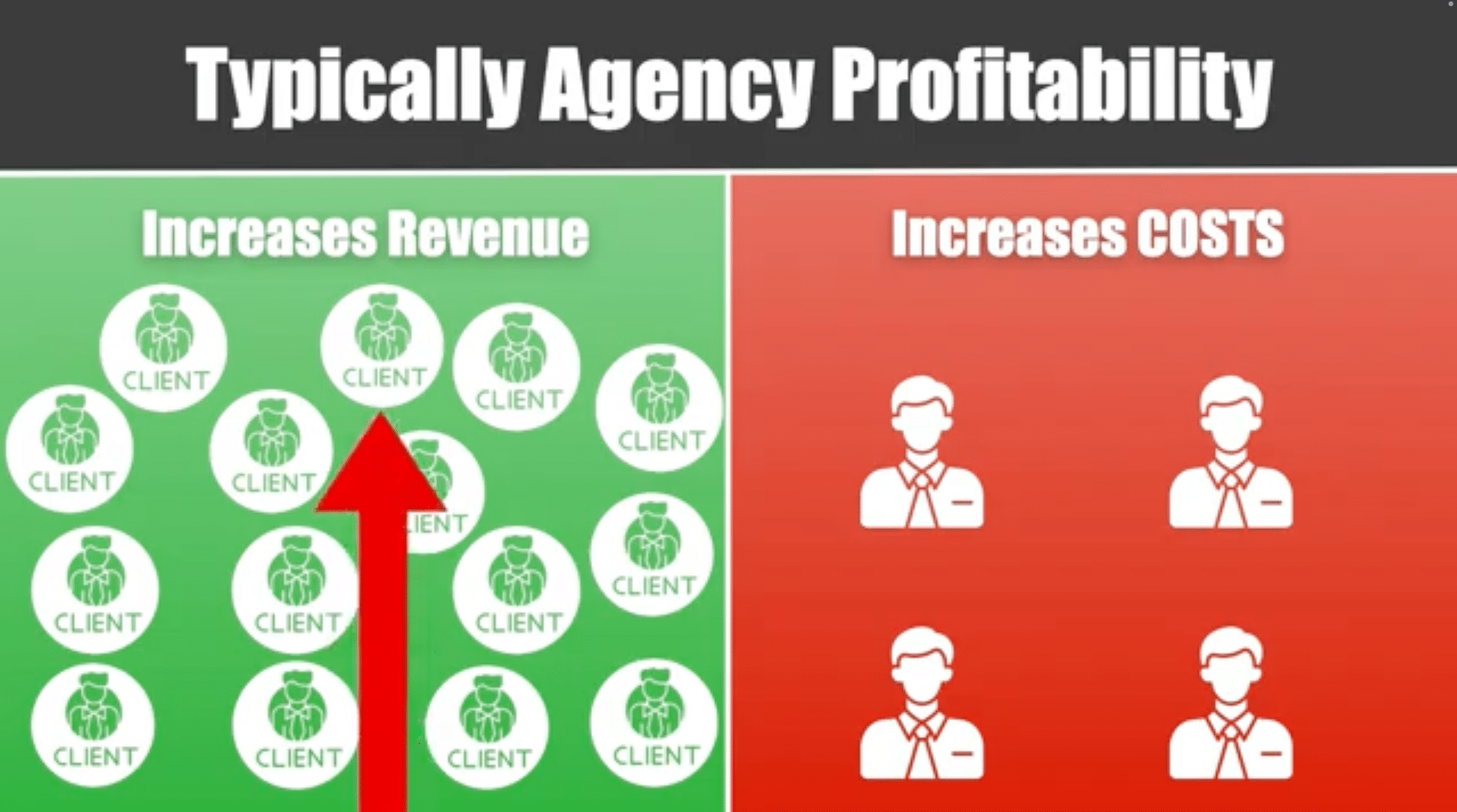
Image above: Many retainer agencies grow revenue by adding clients, not by increasing time spent per account.
In practice, this often shows up as:
- Overloaded account managers
- Heavy automation
- Standardized processes that aren’t truly adapted to your brand
- Slow communication when you need real answers
And if you need more work done, the cost usually adjusts upward (upgrade your package, add fees, expand scope).
If you need less work done, the cost usually does not adjust downward.
That mismatch matters because Amazon doesn’t behave in a smooth, predictable monthly pattern.
| Contract / billing feature | Why it matters to you |
|---|---|
| 3–12 month commitments | You may pay before Amazon is validated as a channel |
| 30–90 day cancellation notice | Often means paying extra months during “wind-down” effort |
| Fixed scope packages | Weird problems may be “not included” (you still end up DIY) |
| Retainer doesn’t shrink when workload shrinks | You overpay during stable months |
| Paying based on ad spend or % of sales | Incentives can drift toward spending more, not profit |
The flexible hybrid approach (the model that fits how Amazon actually works)
So DIY has predictable problems, and agencies have predictable problems.
Either option might be good for you in certain situations.
But for most brands, neither rigid approach works particularly well long term.
That’s why I usually recommend a third operating model: a flexible hybrid structure.
The idea is simple:
- Use experts for the specialized, high-risk, high-impact Amazon work.
- Keep the easy, repeatable parts in-house (after training).
- Scale agency involvement up or down as your workload spikes and drops.
| If you are… | DIY is usually… | Traditional agency retainer is usually… | Hybrid is usually… |
|---|---|---|---|
| Pre-revenue / tiny budget | The only realistic option | Usually a bad fit | A good fit if you use it as targeted consulting (not full management) |
| Established brand, new to Amazon | Risky unless you have an experienced Amazon hire | Sometimes good, but often rigid and expensive early | Often best (experts handle setup + issues, internal team keeps ownership) |
| Established brand with stable catalog + stable ad spend | Possible if internal team is strong | Can work well | Still strong if you want flexibility and transparency |
| Rapid growth / frequent launches / constant changes | Hard to keep up | Can work if agency truly gives attention | Usually best because you can scale hours up/down quickly |
| You want maximum control over decisions | Strong fit | Sometimes frustrating | Strong fit (control + expertise) |
| You need specialized Amazon knowledge quickly (compliance, suppression, catalog) | Weak fit | Depends on agency quality and scope | Strong fit (pull in experts only when needed) |
Why hourly matters
Hourly pricing aligns cost directly with the real workload.
If you need 30 hours during a product launch, you pay for 30 hours.
If you need 10 hours the following month, you pay for 10 hours.
You pay for exactly what you use — no more, no less.
No padding.

Image above: Amazon workload is front-loaded, then drops, then spikes again — which is why rigid monthly retainers don’t map cleanly to reality.
Hourly also changes the relationship dynamic.
Because they’re being paid for time, a good team will:
- Give you more attention when you need it
- Explain what they’re doing and why
- Train you or your team if that’s what makes sense
- Spend the time required to solve weird, one-off issues without hiding behind scope language
Why “no minimums” matters
Even a small monthly minimum reduces the flexibility of the relationship.
If you’re required to use a set number of hours each month:
- You overpay when you don’t need help, or
- You use hours on low-value tasks just so they don’t “go to waste.”
More importantly, minimums get in the way of gradually shifting work in-house over time (or shifting it back out when your team gets overloaded).
Why you should be able to stop anytime
If you’re validating Amazon as a channel, you shouldn’t be locked into months of cost before you know whether it’s working.
If your internal team becomes capable enough to manage things independently, you shouldn’t be penalized for that progress.
Flexibility only works if the relationship is voluntary every month.
Training and transparency
If the external team just executes behind the scenes, you still become dependent on them.
In a proper flexible hybrid structure, when something is fixed, you can ask why — and they’ll take the time to explain it.
Over time, your internal capability increases instead of staying flat.
| Hybrid requirement | Pass/Fail question you should ask |
|---|---|
| Hourly billing | “Do you bill only for time worked with time logs?” |
| No minimums | “Is there any required monthly minimum?” |
| Stop anytime | “Can we pause or stop without notice periods?” |
| Training + transparency | “Will you teach our team as we go and explain decisions?” |
| Cost you’ll feel | DIY (solo or internal team) | Traditional agency | Hybrid |
|---|---|---|---|
| Time delays (approvals, errors, getting stuck) | High risk | Lower risk | Lower risk |
| Paying for downtime (slow months / stockouts / delays) | N/A (time cost still exists) | Common | Avoidable (scale down hours) |
| Fixing mistakes later | Common | Depends | Lower risk (expert oversight early) |
| Opportunity cost (time away from product, supply chain, other channels) | High | Lower | Medium (you stay involved, but less stuck) |
| Dependency risk | Low | Higher | Lower (training + transparency) |
| “Scope not included” moments | N/A | Common | Less common if hourly + flexible |
One-time setup work vs recurring management work
One of the most useful ways to think about Amazon operations is separating one-time setup work from recurring work.
In the beginning, there’s a lot of one-time work that needs to be done correctly and quickly:
- Seller account setup and identity verification
- Brand Registry setup
- Catalog structure decisions (variations, parent/child, UPC/GTIN structure, etc.)
- Initial listing creation and compliance groundwork
- Initial PPC setup
These are complicated. And most of them are things you’ll never have to “learn from scratch” again once they’re set up correctly.
That’s why it often makes sense to pay an expert to handle that phase.
But once the account is live and stable, much of the ongoing work becomes recurring and predictable:
- Inventory monitoring and replenishment planning
- Basic promotions and discounts
- Review and feedback monitoring
- Customer messages
- Routine PPC optimizations
These can often move in-house -- especially after training.
| Recurring Work | One-Time Work |
|---|---|
|
|
Most brands should treat Amazon like two different work buckets — one-time setup work that must be done correctly, and recurring work that can often be trained and handled internally.
If you structure your Amazon operation this way, you get a much better long-term outcome if you don't have the budget to use an agency on an ongoing basis:
- You pay experts for high-skill one-time work.
- You train internal team members to handle recurring tasks efficiently.
- You keep experts available for unusual, urgent, or technical problems.
That structure also helps you avoid one of the biggest hidden drains on Amazon profitability: paying a full retainer forever, even when the real workload isn’t there.
Agency pricing models (and why structure matters more than the rate)
Agencies price their services in a few common ways. The model you pick often matters more than the monthly number, because the model shapes incentives and flexibility.
If you want a deeper breakdown, here’s the full pricing model comparison:
Hourly vs Monthly Retainer vs Flat Project vs % of Sales.
| Model | Best For | Predictability | Flexibility | Common Risk |
|---|---|---|---|---|
| Hourly | Brands that want to scale support up/down | Medium | High | Billing varies month to month unless you set a cap |
| Monthly retainer | Stable workload, hands-off brands | High | Medium | Overpaying during slow months + low attention per account |
| Flat project | One-time deliverables | High | Low | Fragmented strategy + no follow-through |
| % of sales | Rare partnerships, usually already-successful brands | Low | Low | Incentives can push ad spend or lock you into contracts |
Case study examples (what “flexible” can look like in real life)
I’m not including these as guarantees (Amazon doesn’t work that way), but they’re useful examples of how flexible support and targeted execution often plays out.
- Skincare brand case study: $900/month to $18K/month in 5 months (about $6,000 spent on our time).
- Consulting case study: $70K/month to $140K/month in 5 months (under $900 spent on consulting time, driven largely by an FBA switch).
- Smart device brand case study: launched to $200K–$500K/month in 18 months (minimal average spend due to a strong internal team).
The theme across these isn’t “magic tactics.” It’s the operating structure:
- Use experts where expertise matters.
- Keep ownership internally where internal context matters.
- Scale involvement up and down as the workload changes.
Where Five Star Commerce fits (as one example of this model)
Very few agencies are structured with true flexibility, because retainers and contracts are easier for agencies to run internally.
But for brands, that structure often doesn’t match how Amazon actually behaves.
My team is called Five Star Commerce, and we intentionally built around the flexible hybrid approach:
- We work hourly.
- We have no minimums.
- You can stop at any time.
- We can train and work alongside internal teams instead of forcing dependence.
If you want a quick comparison of how this differs from traditional agencies, employees, and freelancers, here’s another useful read:
Five Star Commerce vs. Most Agencies, Employees & Freelancers.
And if Brand Registry is part of your decision-making (or you’re stuck in that process), this is one of the most misunderstood areas on Amazon:
How Amazon Brand Registry Works (And What It Doesn’t Do).
FAQ
Is it realistic to do Amazon completely DIY long term?
It can be, but most brands eventually run into weird issues that are hard to solve without someone who lives inside Seller Central across many accounts. The bigger problem is time: time spent stuck in approvals, suppressions, or policy confusion is time you’re not spending improving your product, supply chain, or core marketing.
When does hiring an agency make the most sense?
Agencies tend to make the most sense when you have a stable workload, you want to be hands-off, and you’re comfortable with a fixed monthly cost. For many brands, this is a better fit later — not at the very beginning — because the early-stage uncertainty makes long contracts and fixed retainers risky.
What’s the biggest risk of a monthly retainer?
The biggest risk is misalignment: you pay the same amount whether your account needs 30 hours of attention or 5 hours. And many agencies have incentives to minimize time per client as they grow.
What does a “hybrid model” look like in practice?
Typically, experts handle the high-skill tasks (setup, compliance, catalog issues, PPC architecture, and weird emergencies), and your internal team handles repeatable tasks (inventory tracking, routine promo cadence, customer messages, etc.) after training.
If we go hybrid, what’s the biggest thing we need to get right?
Clarity on responsibilities. If both parties assume the other is doing something, it won’t get done. A hybrid model works best when roles are clearly defined, there’s a single point of contact, and communication is consistent.
| Model | Flexibility | Cost control | Dependency risk | Speed to resolve weird issues |
|---|---|---|---|---|
| 100% DIY | 🟥 | 🟩 | 🟩 | 🟥 |
| Retainer agency | 🟥 | 🟥 | 🟥 | 🟨 |
| Flexible hybrid | 🟩 | 🟩 | 🟩 | 🟩 |
Wrapping it up
DIY can work.
Traditional agencies can work.
But both are rigid.
Amazon is not predictable. Your operating structure should reflect that.
Instead of asking: “Should we hire an agency?” ask: “How should our Amazon operation be structured so it can adapt over time?”
If you want a walkthrough, the video above covers this step-by-step. If you’ve got a quick question about your situation, leave a comment on the video and I’ll try to point you in the right direction. And if your situation is more complex and you want professional help, reach out to us at customerservice@fivestarcommerce.com or schedule an info call using the “Schedule info call” button on our website:
Schedule an info call.
(If you just want to see what we help with day-to-day, this is the services overview:
Five Star Commerce services for Amazon and Walmart.)